
In the ever-evolving world of internet slang, “touch grass” has emerged as one of the most ubiquitous and versatile phrases of the digital age. If you’ve spent any time on social media platforms like Twitter (now X), TikTok, Reddit, or Instagram, you’ve almost certainly encountered it—either as a dismissive comeback in an online argument or as a humorous self-admission of spending too much time indoors. But what does “touch grass” actually mean?
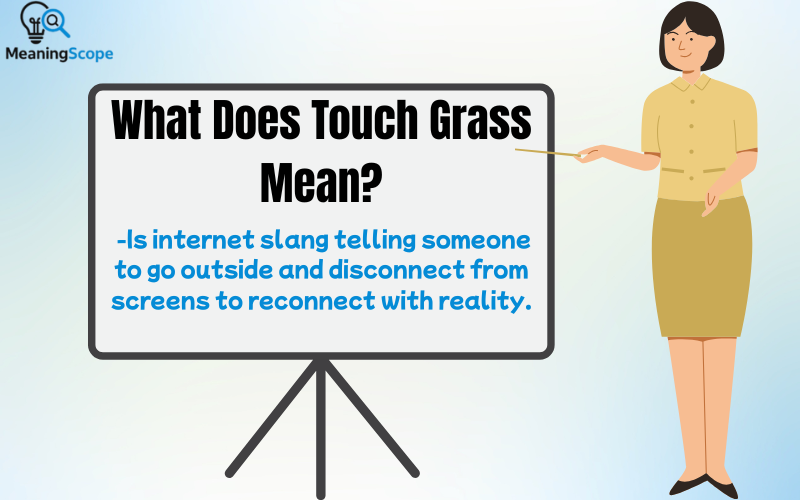
At its simplest, “touch grass” is an internet idiom urging someone to go outside, disconnect from screens, and reconnect with the real world by literally or figuratively touching grass. It’s often used to suggest that a person is “chronically online,” meaning they’ve spent so much time immersed in digital spaces that their perspective has become detached from everyday reality. The phrase can be lighthearted banter among friends, a gentle reminder for self-care, or a sharp insult to shut down overly intense online behavior.
Coined in gaming and online communities, “touch grass” gained explosive popularity during the COVID-19 pandemic when lockdowns forced many people indoors, amplifying screen time. Today, in late 2025, it remains a staple of Gen Z and millennial discourse, symbolizing the tension between our hyper-connected virtual lives and the need for grounding in nature. This comprehensive article explores every angle of the phrase: its history, origins, evolution, cultural impact, myths, facts, usages, variations, and more. Whether you’re puzzled by a comment telling you to “touch grass” or curious about its deeper implications for mental health and society, this guide provides an in-depth, informative breakdown to help you fully understand this modern meme.
The History of “Touch Grass”: From Obscure Insult to Global Meme
The history of “touch grass” is intrinsically tied to the rise of internet culture in the 2010s and 2020s. While isolated uses of similar phrases appear as early as 2015 on Twitter, the term didn’t gain traction until around 2019. It originated in online gaming communities, where players spending hours in virtual worlds would mock “ragers”—those who became excessively angry or delusional during games—by telling them to “touch grass” as a way to say, “Log off and experience real life.”
The phrase’s popularity surged in 2020 and exploded in 2021, coinciding with global lockdowns that confined billions to their homes. With increased screen time leading to heightened online conflicts, “touch grass” became a quick, witty retort to dismiss opinions perceived as out of touch. Platforms like Twitter and 4chan were early hotspots, but it quickly spread to TikTok, Reddit, and Instagram through memes and viral threads.
By 2021, Urban Dictionary entries proliferated, solidifying its meaning, and image macros featuring hands touching grass (often with humorous captions) flooded social media. The meme peaked amid discussions of digital wellbeing, with users self-deprecatingly admitting, “I need to touch grass.” As of 2025, it has entered mainstream lexicon, referenced in news articles, celebrity interviews, and even dictionary additions like Merriam-Webster, which defines it as participating in real-world activities opposed to online ones.
This historical trajectory reflects broader societal shifts: from pre-internet eras where “go outside” was parental advice, to a digital-native generation using “touch grass” to navigate the pitfalls of constant connectivity. Its rise also parallels growing awareness of screen addiction, making it not just slang but a cultural commentary on modern life.
Etymology and Origin: Unpacking the Phrase
Etymologically, “touch grass” is straightforward yet evocative. “Touch” implies direct physical contact, while “grass” symbolizes the natural, outdoor world—simple, ubiquitous, and grounding. The phrase isn’t a portmanteau or acronym but a literal suggestion turned metaphorical insult.
Its exact origin remains unknown, with no single creator credited. Early traces date to Twitter posts around 2015, but significant spread began in 2019 within anime, gaming, and fandom circles on platforms like 4chan and Twitter. One notable early example from May 2019 criticized obsessive fans, telling them to “touch some grass.”
The choice of “grass” is deliberate: it’s something basic and elemental that even the most isolated indoor dweller should recognize. It contrasts the tactile reality of nature with the intangible digital realm. Linguistically, it draws from older expressions like “get some fresh air” or “go play outside,” but adds a derogatory edge unique to internet discourse.
In non-English contexts, equivalents have emerged, but “touch grass” dominates globally due to English’s prevalence online. Its etymology highlights how slang evolves organically in anonymous online spaces, spreading virally without formal invention.
Evolution in Popular Culture: From Gaming Jargon to Mainstream Advice
“Touch grass” has evolved dramatically from niche gaming insult to widespread cultural phenomenon. In its early days (2019-2020), it was primarily antagonistic, used in heated debates to imply someone was delusional from excessive online time.
The pandemic accelerated its shift: as remote work and virtual socializing became norms, the phrase gained a dual tone—still mocking, but also prescriptive. By 2021, it appeared in memes acknowledging personal overindulgence, like “I haven’t touched grass in weeks.”
Popular culture embraced it further. Celebrities and influencers referenced it in interviews, clapping back at trolls. Memes evolved into formats like “Touching grass is not enough, I need…” for exaggerated humor. It infiltrated non-gaming spaces, including politics, crypto communities (where traders obsessed with charts were told to touch grass), and mental health discussions.
In 2025, it’s often used positively, aligning with wellness trends like “grounding” (earthing therapy). Brands and media promote it as self-care advice, while variations appear in TV scripts and songs. This evolution mirrors society’s reckoning with technology: from dismissal to a balanced reminder of offline life’s value.
Facts About “Touch Grass”: Key Insights and Statistics
“Touch grass” is backed by intriguing facts that underscore its relevance. Fact: Excessive screen time correlates with mental health issues; studies from 2023-2025 show that adults averaging over 7 hours daily report higher anxiety, with nature exposure reducing stress by up to 20%.
Another fact: The phrase’s popularity spiked 500% on Twitter in 2021 per analytics tools. It’s predominantly used by Gen Z (ages 18-28), who spend an average of 4-6 hours daily on social media.
Scientifically, “touching grass” has merit—grounding involves direct contact with earth, potentially lowering inflammation via electron transfer. A 2024 review found nature walks improve mood and cognition.
Factually, it’s gender-neutral but often directed at perceived “terminally online” behaviors in male-dominated spaces like gaming. Globally, it’s adapted in memes across cultures, promoting digital detox amid rising smartphone addiction rates (over 6 billion users in 2025).
These facts reveal “touch grass” as more than mockery—it’s a cultural nudge toward healthier habits.
Myths and Misconceptions: Debunking Common Beliefs
Several myths surround “touch grass.” Myth: It’s always a harsh insult. While often derogatory, it can be playful or self-directed encouragement.
Another myth: It’s ableist, excluding those unable to go outside. Critics in 2021 argued this, but defenders note it’s metaphorical for gaining perspective, not literal.
Myth: The phrase is new. It builds on timeless advice to “go outside,” just digitized.
People believe it’s only for gamers—false; it’s used across politics, fandoms, and work.
Finally, myth: Touching grass “cures” online addiction. It’s symbolic; real change requires sustained effort. Debunking these shows the phrase’s nuance.
Contextual Usage: How and When to Use “Touch Grass”
Context determines “touch grass’s” tone. In arguments: Dismissive, e.g., “Your take is wild—touch grass.”
Playfully: Among friends, “We’ve been scrolling forever, let’s touch grass.”
Self-referentially: “This debate is toxic; I need to touch grass.”
On platforms: Twitter for quick retorts, TikTok for video responses showing actual grass-touching.
Negative contexts: Escalating toxicity. Positive: Wellness posts encouraging breaks.
Understanding context avoids misuse; it’s best when highlighting imbalance without cruelty.
Variations and Spellings: Creative Twists on the Phrase
Variations abound: “Go touch some grass,” “Touch some grass,” “Grass has been touched” (post-break admission).
Memes: “Touching grass is not enough, I need [extreme thing].”
Others: “I touched grass today” (brag or irony), “No grass touched.”
Spellings: Usually standard, but emphatic like “TOUCH GRASS!!”
These keep it fresh and adaptable.
Impact on Society and Mental Health: Broader Implications
“Touch grass” impacts society by spotlighting digital overload. It promotes mental health awareness, encouraging nature for stress relief.
Positively: Fosters community in shared self-awareness.
Negatively: Can shame or escalate conflicts.
In 2025, it influences policy discussions on screen time limits and digital wellness campaigns.
“Touch Grass” in Memes and Media: Viral Examples
Memes feature hands on grass with captions like unchanged bigoted views post-“touching.”
Media: Referenced in articles, shows, celebrity responses to hate.
Psychological Aspects: Why the Phrase Resonates
Psychologically, it addresses parasocial overinvestment and echo chambers. Nature exposure boosts serotonin; the phrase taps into guilt over imbalance.
Pros and Cons of Heeding “Touch Grass”
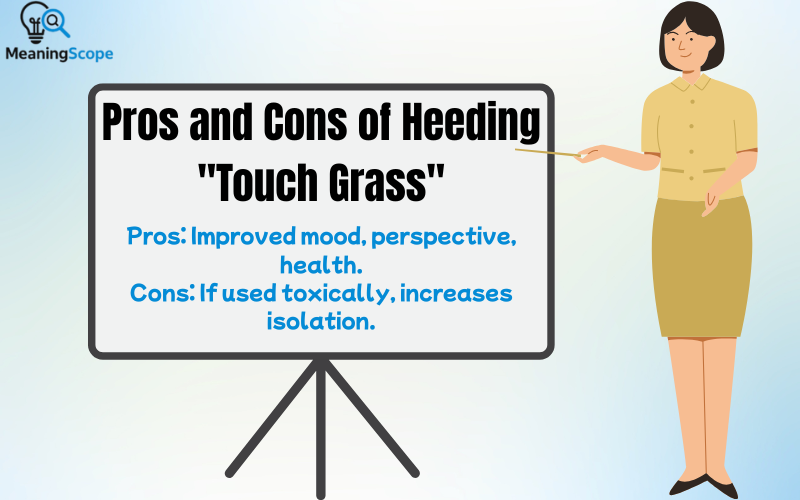
Pros: Improved mood, perspective, health.
Cons: If used toxically, increases isolation.
Famous Uses and Celebrity References
Celebrities like Rachel Zegler have used it against trolls.
How to Respond When Told to “Touch Grass”
Humorously: Post grass photo. Or reflect if valid.
Related Post: What Does Stan Mean? Uses, History, Meaning And All Info
(FAQs)
Is “touch grass” always an insult?
No, it can be humorous advice or self-reflection, though often dismissive.
Where did “touch grass” originate?
From online gaming communities around 2019, exploding in popularity by 2021 during the pandemic.
Does literally touching grass help?
Yes, via grounding and nature benefits, reducing stress and improving wellbeing.
Conclusion:
“Touch grass” started as internet snark but evolved into a profound reminder of balance in our screen-dominated world. From its obscure origins to viral status, it captures the joys and pitfalls of digital life while advocating for real-world connection. In 2025, as technology advances, the phrase endures as witty wisdom: sometimes, stepping away is the best response. Whether dismissing drama or seeking clarity, embracing “touch grass” can enrich our lives—literally and figuratively.
