
In the diverse world of music genres and youth subcultures, few terms evoke as much passion, nostalgia, and misunderstanding as “emo.” Whether you’ve heard it thrown around in casual conversations, seen it in memes, or associated it with a specific era of music and fashion, “emo” has become a multifaceted label. But what does “emo” really mean?
At its foundation, “emo” is short for “emotional hardcore” or “emocore,” a rock music genre that emphasizes confessional, introspective lyrics paired with melodic yet intense instrumentation. Beyond music, it evolved into a subculture defined by expressive fashion, emotional vulnerability, and a sense of community among those feeling misunderstood. In modern slang, especially among Gen Z in 2025, “emo” often describes someone overly sensitive, moody, or nostalgic for early 2000s aesthetics—sometimes used playfully, sometimes derogatorily.
From its underground roots in the 1980s hardcore punk scene to mainstream explosion in the 2000s with bands like My Chemical Romance and Paramore, and its ongoing revivals in the 2020s, “emo” represents more than a trend—it’s a cultural phenomenon celebrating raw emotion. This in-depth article explores every aspect: history, origins, evolution, fashion, music, myths, current slang usage, stereotypes, and much more. By the end, you’ll have a complete understanding of “emo” in all its forms, debunking misconceptions and highlighting its enduring influence.
The History of Emo: From Hardcore Roots to Mainstream Phenomenon
The history of emo traces back to the mid-1980s in Washington, D.C., during the “Revolution Summer” of 1985. Disillusioned with the aggressive, violent tendencies of hardcore punk, bands like Rites of Spring, Embrace (featuring Ian MacKaye of Minor Threat and Fugazi fame), and Dag Nasty pioneered a new sound: faster punk riffs infused with deeply personal, emotional lyrics about heartbreak, introspection, and vulnerability. Fans and critics dubbed this “emotional hardcore” or “emocore,” shortened to “emo.”
This first wave remained underground, centered in D.C.’s DIY scene. By the early 1990s, the second wave emerged in the Midwest, with bands like Sunny Day Real Estate, Jawbreaker, and The Promise Ring blending emo with indie rock and pop elements—often called “Midwest emo.” Lyrics grew more poetic, instrumentation twinklier with math rock influences.
The third wave hit in the late 1990s and early 2000s, shifting toward emo pop with bands like Jimmy Eat World (“The Middle”) and Dashboard Confessional, whose acoustic confessional style brought emotional lyrics to broader audiences.
The fourth wave exploded in the mid-2000s, dominating mainstream charts. Bands like My Chemical Romance, Fall Out Boy, Panic! at the Disco, Paramore, and Hawthorne Heights fused emo with pop-punk, theatrical elements, and anthemic choruses. Albums like My Chemical Romance’s The Black Parade (2006) and Fall Out Boy’s From Under the Cork Tree (2005) defined this era, alongside festivals and MySpace’s role in fan connections.
By the late 2000s, backlash grew—media sensationalized emo as linked to depression and self-harm, leading to declining popularity. Many bands disbanded or evolved styles. However, the 2010s saw a revival (fourth/fifth wave) with Midwest emo influences in bands like Modern Baseball and The Hotelier.
In the 2020s, emo experiences ongoing revivals: nostalgia-driven reunions (e.g., My Chemical Romance’s 2022 tour), emo rap influences, and new waves blending hyperpop or screamo. As of late 2025, festivals like When We Were Young keep the spirit alive, with Gen Z embracing “rawring 20s” aesthetics on TikTok.
This rich history shows emo as resilient, continually reinventing while staying true to emotional expression.
Etymology and Origins: The Birth of “Emo”
“Emo” derives from “emocore” or “emotional hardcore,” coined in the 1980s D.C. scene. A Thrasher magazine reference to “emo-core” in the mid-80s popularized it, though bands like Rites of Spring rejected the label, seeing themselves as punk.
The term highlighted the shift from hardcore’s political aggression to personal catharsis. Guy Picciotto of Rites of Spring emphasized vulnerability over machismo. Origins tie deeply to post-hardcore and punk, reacting against genre norms.
Globally, “emo” spread via the internet, influencing scenes in the UK, Japan, and beyond. Today, it encompasses music, fashion, and attitude, far from its niche beginnings.
Evolution in Popular Culture: Waves and Revivals
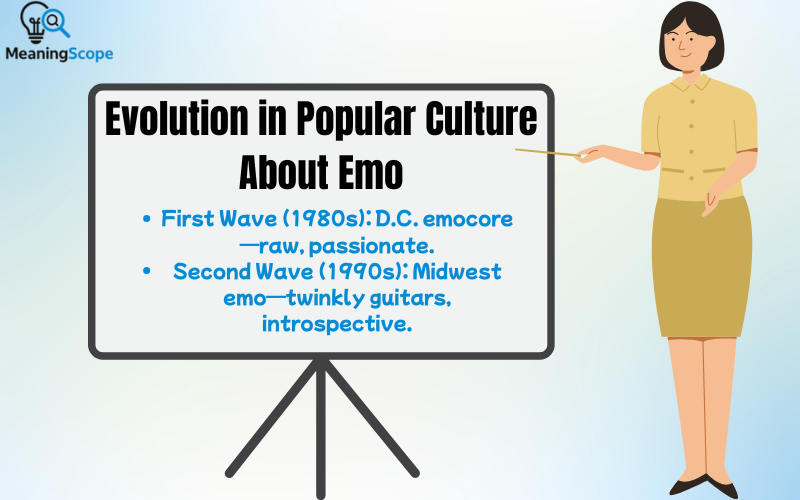
Emo’s evolution spans distinct waves:
- First Wave (1980s): D.C. emocore—raw, passionate.
- Second Wave (1990s): Midwest emo—twinkly guitars, introspective.
- Third Wave (Late 1990s-Early 2000s): Emo pop emerges, more accessible.
- Fourth Wave (Mid-2000s): Mainstream peak, “mall emo” with theatrical flair.
- Revival Waves (2010s-2020s): Underground resurgence, then nostalgia boom with emo rap (Lil Peep) and hyperpop fusions.
In pop culture, emo influenced TV (e.g., South Park parodies), films (Twilight soundtrack), and fashion. The 2020s “RAWRing 20s” revival blends Y2K nostalgia with modern twists, seen in TikTok trends and artists like Machine Gun Kelly.
Emo evolved from rebellion to mainstream acceptance, then cyclic revivals, proving its timeless appeal.
Facts About Emo Culture: Key Insights
Emo boasts fascinating facts:
- Pioneered by Rites of Spring’s 1985 album, often called the first emo record.
- My Chemical Romance’s The Black Parade sold over 4 million copies, cementing emo’s commercial height.
- Emo fashion influenced global trends: skinny jeans became ubiquitous.
- In 2025, emo streams surge on Spotify, driven by Gen Z nostalgia.
- Emo communities raised awareness for mental health, though often misrepresented.
- Bands like Paramore (fronted by Hayley Williams) broke gender barriers in a male-dominated scene.
These facts highlight emo’s depth beyond stereotypes.
Myths and Misconceptions: Debunking Stereotypes
Emo faces persistent myths:
- All emos self-harm or are suicidal: A harmful stereotype from 2000s media sensationalism. Most fans are healthy enthusiasts; self-harm isn’t inherent.
- Emo is just for depressed teens: Emo celebrates all emotions—joy, anger, love. Fans span ages and moods.
- Emos hate everything and are antisocial: Many are outgoing, forming tight communities.
- It’s a phase or poser trend: For many, it’s genuine identity; “posers” exist in every subculture.
- Emo music is only sad screaming: Ranges from melodic indie to anthemic pop-punk.
- All emos look the same: Fashion varies by wave and individual.
Debunking these reveals emo as empowering emotional expression.
Contextual Usage: Emo in Music, Fashion, and Slang
Context shapes “emo”:
- Music: Confessional lyrics, e.g., “I’m Not Okay” by MCR.
- Fashion: Jet-black hair with bangs, eyeliner, band tees, skinny jeans (2000s peak).
- Slang (2025): “Feeling emo” means moody/sensitive; “emo era” for nostalgic phase.
Used positively in communities, negatively as insult elsewhere.
Variations and Styles: Subgenres and Aesthetics
Variations include:
- Midwest emo (twinkly).
- Emo pop (catchy).
- Screamo (intense vocals).
- Emo rap (modern fusion).
Aesthetics: Clean-cut 90s to dramatic 2000s, soft grunge 2010s.
Impact on Society: Mental Health and Expression
Emo normalized vulnerability, aiding mental health discussions. Backlash highlighted stigma. Positively, fostered belonging for marginalized youth.
Famous Emo Bands and Artists: Icons of the Genre
Key acts:
- Rites of Spring (origins).
- Sunny Day Real Estate.
- Jimmy Eat World.
- Dashboard Confessional.
- My Chemical Romance.
- Fall Out Boy.
- Paramore.
- Panic! at the Disco.
- Hawthorne Heights.
Modern: Origami Angel, newer revivals.
Emo Fashion Through the Decades
1980s-90s: Geek chic, cardigans.
2000s: Black hair, eyeliner, studs.
2010s-2020s: Revived with neon, hyperpop twists.
Psychological Aspects: Why Emo Resonates
Emo fulfills needs for validation, community. Parasocial bonds with artists provide catharsis.
Pros and Cons of Emo Culture
Pros: Emotional outlet, creativity.
Cons: Stereotyping, past toxicity.
Emo in the 2020s: Current Status and Revival
Ongoing revival with nostalgia, new bands, TikTok trends.
Related Post: What Does Touch Grass Mean? Uses, Facts, History, Myths
(FAQs)
Is emo still a thing in 2025?
Yes, through revivals, streaming, and fashion trends.
What’s the difference between emo and goth/scene?
Emo focuses on emotional punk roots; goth darker/macabre; scene more colorful/MySpace-era.
Do all emo fans cut themselves?
No, that’s a debunked stereotype; most are healthy.
Conclusion:
“Emo” began as a musical rebellion emphasizing emotion but grew into a powerful subculture and slang term celebrating vulnerability. From D.C. hardcore to 2020s revivals, it mirrors societal needs for authentic expression. Despite myths, emo empowers millions, proving feelings are strength. In 2025, its influence persists—reminding us it’s okay to feel deeply.
