
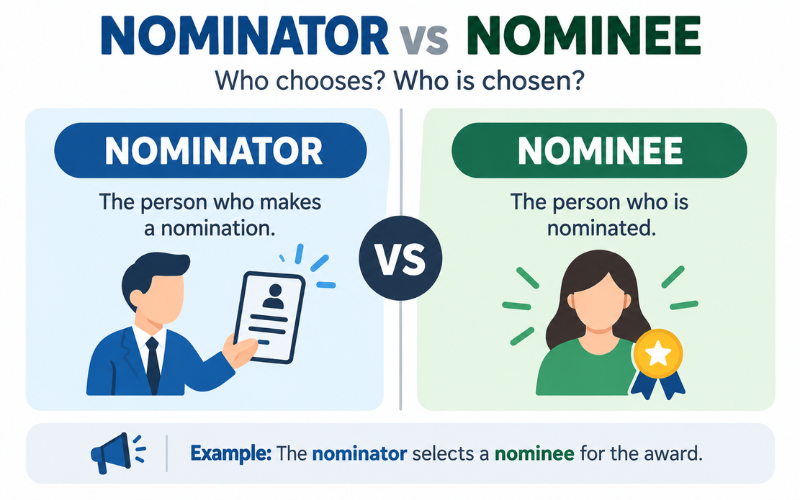
The words nominator and nominee are closely connected, but they do not mean the same thing. Both terms appear in awards, scholarships, elections, professional recognition, workplace programs, fellowships, and other situations where a person or organization is put forward for consideration. The confusion usually happens because both words come from the same root word, nominate.
The easiest way to understand the nominator vs nominee differences is to focus on the direction of the action. The nominator is the person or organization that makes the nomination, while the nominee is the person or entity being nominated. For example, if Sarah recommends James for an employee award, Sarah is the nominator, and James is the nominee. Sarah takes the action of putting James forward, while James becomes the person being considered.
Although this basic difference is simple, the two terms can become confusing when a nomination process includes several people, recommendation letters, committees, applications, supporting documents, eligibility requirements, or self-nomination. In some situations, the same individual can even be both the nominator and nominee.
This article explains the difference between a nominator and a nominee in clear, practical language. It covers their definitions, responsibilities, similarities, differences, examples, common mistakes, formal usage, nomination forms, and frequently asked questions.
Nominator vs Nominee: The Quick Difference
The quickest way to distinguish the two terms is to ask who performs the nomination and who is being nominated.
| Term | Meaning | Role | Example |
| Nominator | The person or organization that nominates someone | Makes or submits the nomination | Maria recommends David |
| Nominee | The person or entity being nominated | Is put forward for consideration | David is nominated |
| Nominate | To put someone forward for consideration | Verb | Maria nominates David |
| Nomination | The act or submission of nominating | Noun | Maria submits a nomination |
| Selection committee | The group that reviews or selects candidates | Reviewing body | The committee evaluates nominees |
A simple formula makes the relationship clear:
Nominator → nominates → Nominee
For example:
Maria nominated David for an award.
Maria is the nominator because she made the nomination.
David is the nominee because he was nominated.
The two terms describe different roles within the same process.
What Does Nominator Mean?
A nominator is a person or organization that formally proposes, recommends, or puts another person or entity forward for consideration.
The term comes from the verb nominate. When someone nominates another person, the person making that nomination is called the nominator.
For example:
John nominated Lisa for an award.
In this sentence:
- John is the nominator.
- Lisa is the nominee.
- The award is what Lisa is being considered for.
The nominator may be a teacher, manager, colleague, friend, organization, professional association, committee member, or another eligible individual. The exact eligibility requirements depend on the nomination program.
Simple Definition of Nominator
Nominator: A person or organization that puts another person or entity forward for consideration for an award, position, honor, scholarship, membership, fellowship, or similar opportunity.
The most important idea is action.
The nominator is the person who takes the step of saying, essentially:
“I believe this person should be considered.”
Depending on the process, the nominator may have to complete a form, write a statement, provide supporting information, or submit evidence explaining why the nominee deserves consideration.
Example of a Nominator
Imagine a company accepts nominations for its annual Outstanding Employee Award.
Emma believes that her colleague Daniel deserves the award. She completes the nomination form and describes Daniel’s achievements.
In this situation:
- Emma = nominator
- Daniel = nominee
- Outstanding Employee Award = award
- Company committee = selection body
Emma’s role is to make the nomination. She is not the person being considered for that particular nomination.
What Does Nominee Mean?
A nominee is a person or entity that has been proposed for consideration.
In simple terms, the nominee is the subject of the nomination.
If a teacher nominates a student for a scholarship, the student is the nominee.
If a manager nominates an employee for an internal award, the employee is the nominee.
If an organization nominates a team for recognition, the team may be the nominee.
Simple Definition of Nominee
Nominee: A person or entity that has been put forward for consideration for an award, position, honor, election, membership, scholarship, fellowship, or similar opportunity.
The key idea is being considered.
For example:
The school principal nominated Olivia for a student leadership award.
The principal is the nominator.
Olivia is the nominee.
The organization receiving the nomination may then review Olivia’s qualifications and decide whether she meets its requirements.
Example of a Nominee
Suppose a manager recommends an employee for an annual leadership award.
The manager submits the nomination.
The employee becomes the nominee.
The employee may later be selected as a finalist, win the award, or not be selected.
Being a nominee therefore describes a person’s position in the nomination process, not necessarily the final result.
Nominator vs Nominee: The Main Difference
The central difference between a nominator and a nominee is who performs the action.
The nominator performs the action of nominating.
The nominee is the person or entity receiving that nomination.
Think of it this way:
Nominator → nomination → Nominee
For example:
Teacher → nominates → Student
Manager → nominates → Employee
Colleague → nominates → Colleague
Organization → nominates → Candidate
This relationship is similar to other English word pairs in which one person performs an action and another person receives or is affected by it.
The important distinction is not who is more important. It is simply who does what.
Nominator vs Nominee Differences at a Glance
The following comparison makes the difference easier to see.
| Difference | Nominator | Nominee |
| Main role | Makes the nomination | Is nominated |
| Performs the nomination | Yes | Usually no |
| Is put forward for consideration | Usually no | Yes |
| May submit a nomination form | Often | Sometimes |
| May provide supporting information | Often | Sometimes |
| May need to meet eligibility rules | Depends on the process | Usually |
| May receive the award | Not because of the nomination itself | Potentially |
| Can be an organization | Yes | Yes, depending on context |
| Can be the same person | Yes, through self-nomination | Yes |
| Role in the process | Nominator or submitter | Candidate or subject of nomination |
The word usually is important because nomination procedures are not identical everywhere.
Some programs allow only another person to nominate a candidate. Others permit self-nomination. Some require the nominee to accept the nomination, while others do not.
Nominator vs Nominee in Simple Terms
If you need the shortest possible explanation, remember these two statements.
Nominator
The nominator is the person who says:
“I nominate this person.”
Nominee
The nominee is the person about whom the nomination is made.
For example:
Ahmed nominated Sara for the leadership award.
Here:
- Ahmed = nominator
- Sara = nominee
This distinction works across many situations, whether the nomination involves a school award, scholarship, workplace recognition, professional honor, or another opportunity.
How the Nomination Process Works
Understanding the typical nomination process makes the difference between the two words much easier to remember.
The exact procedure depends on the organization, but a common nomination process can follow several stages.
Step 1: Someone Identifies a Candidate
A person or organization decides that someone deserves consideration.
For example, a manager notices that an employee has made an important contribution to a project.
Step 2: The Person Becomes the Nominator
If the manager decides to formally submit the employee’s name, the manager becomes the nominator.
Step 3: The Candidate Becomes the Nominee
The employee who is being put forward becomes the nominee.
Step 4: The Nomination Is Submitted
The nominator may need to provide information such as:
- The nominee’s name
- Background information
- Achievements
- Supporting evidence
- A recommendation
- Relevant documents
- A statement explaining why the nominee deserves consideration
The amount of information required depends on the program.
Step 5: The Nominee May Be Contacted
Some organizations contact the nominee after receiving the nomination.
The nominee may be asked to:
- Confirm participation
- Accept the nomination
- Provide additional information
- Complete an application
- Submit documents
- Answer questions
Other programs may not require any action from the nominee.
Step 6: Nominees Are Evaluated
A committee, panel, organization, employer, institution, or voting body may review the nominees.
The reviewing body may compare candidates according to predetermined criteria.
Step 7: A Decision Is Made
The nominee may eventually:
- Become a finalist
- Be shortlisted
- Win an award
- Receive an appointment
- Advance to another stage
- Be rejected
- Withdraw
- Be found ineligible
This is why being nominated does not automatically mean winning.
Is a Nominee the Same as a Winner?
No.
A nominee is a person or entity being considered. A winner is someone who has ultimately been selected to receive an award or recognition.
For example, imagine five employees are nominated for Employee of the Year.
All five employees are nominees.
If the organization chooses one employee, that person becomes the winner.
The relationship can therefore look like:
Nominee → Finalist → Winner
However, not every nomination process has all of these stages.
The important point is:
Nominee does not mean winner.
Someone can be nominated without receiving the final award.
Is a Nominee the Same as a Candidate?
The words nominee and candidate can overlap, but they are not always identical.
A candidate is generally someone being considered for a position, opportunity, or selection.
A nominee specifically emphasizes that the person has been nominated.
For example:
James is a candidate for the position.
This tells us that James is being considered.
Now consider:
James was nominated for the position by the board.
This sentence provides additional information: it explains how James entered the consideration process.
In some contexts, especially elections, the terms may be used very closely. In other situations, nomination may be one step in a longer process.
The correct terminology should therefore follow the rules and terminology of the specific organization.
Can the Nominator and Nominee Be the Same Person?
Yes, when self-nomination is allowed.
This is an important exception to the usual distinction.
Suppose a fellowship allows people to nominate themselves.
Maria completes the nomination form and submits her own name.
In this situation:
- Maria is the nominator because she submitted the nomination.
- Maria is also the nominee because she is the person being nominated.
The words describe different roles, not necessarily different people.
Example of Self-Nomination
Consider the sentence:
David nominated himself for the scholarship.
David performed the nomination.
David was also the person being nominated.
Therefore, David is both:
Nominator + Nominee
However, self-nomination is not permitted in every program. The rules of the particular award, scholarship, fellowship, election, or opportunity determine whether it is allowed.
Can an Organization Be a Nominator?
Yes.
A nominator does not have to be an individual person.
Depending on the rules, an organization may nominate someone for:
- An award
- A professional honor
- A scholarship
- A fellowship
- Membership
- Recognition
- An industry distinction
- A position or office
For example:
The professional association nominated Dr. Lee for an excellence award.
In this case, the association is the nominator and Dr. Lee is the nominee.
The exact terminology used by each organization may differ, so official forms and instructions should always take priority.
Can an Organization Be a Nominee?
Yes, depending on the type of recognition.
People are commonly nominated, but organizations, institutions, teams, projects, businesses, and other entities can also be nominated.
For example:
The nonprofit organization was nominated for a community service award.
Here, the nonprofit organization is the nominee.
The person or organization that submitted its nomination is the nominator.
This shows that the words are not restricted exclusively to individuals.
Nominator vs Nominee in Awards
Awards are one of the most common contexts in which these words appear.
Imagine a company has an annual Leadership Excellence Award.
Employees are allowed to nominate coworkers.
Michael submits Priya’s name.
In this situation:
- Michael = nominator
- Priya = nominee
- Leadership Excellence Award = award
- Review panel = selection body
Michael may need to explain Priya’s achievements and why she meets the award criteria.
Priya may later be notified about the nomination.
If Priya wins, she becomes the award winner while still being the person who was nominated.
Nomination Does Not Equal Winning
A person can move through several stages:
Nominated → Shortlisted → Finalist → Winner
Not every award uses all these stages, but the example demonstrates why nomination and winning should not be treated as synonyms.
Nominator vs Nominee in Scholarships
Scholarship programs may use nomination procedures in several different ways.
For example, a teacher may nominate a student for a scholarship.
The teacher is the nominator.
The student is the nominee.
A scholarship committee may then review the student’s qualifications.
In another program, students may be permitted to nominate themselves. In that situation, the student could be both nominator and nominee.
The most important lesson is that scholarship procedures can differ, so applicants should always follow the official requirements.
Nominator vs Nominee in Elections
Election terminology can be more complicated because nomination rules differ between electoral systems and jurisdictions.
Generally, a nominator is a person or group that formally proposes someone for an elected position, while the nominee is the person who has been proposed.
For example, an eligible group may nominate an individual for an office.
However, the exact terminology and legal status of a nominee depend on the applicable election rules.
A person who has been nominated is not necessarily someone who has been elected.
The general sequence is:
Nomination → Campaign or consideration → Election → Result
Therefore, being nominated should not be confused with actually holding the elected position.
Nominator vs Nominee in Job Applications
The words can also appear in workplace situations, especially in internal recognition programs, leadership programs, promotions, and professional awards.
Suppose a company asks managers to nominate employees for a leadership development program.
A manager submits an employee’s name.
The manager is the nominator.
The employee is the nominee.
However, nominee should not automatically be treated as another word for job applicant.
An applicant is someone who applies for a position.
A nominee is someone who has been put forward through a nomination.
A particular program may combine nomination and application, but the two concepts remain different.
Nominator vs Nominee in Professional Recognition
Professional associations often use nomination systems to recognize achievements.
Suppose an engineering association asks members to nominate a colleague for a professional achievement award.
The member who submits the nomination is the nominator.
The engineer being recommended is the nominee.
The nomination may describe areas such as:
- Professional achievements
- Contributions to the field
- Leadership
- Service
- Publications
- Projects
- Community contributions
The exact requirements depend on the award or organization.
Nominator vs Nominee in Simple Everyday Examples
Examples are one of the easiest ways to understand the difference.
Example 1: School Award
Ms. Brown nominated Ethan for Student of the Year.
Ms. Brown = nominator
Ethan = nominee
Example 2: Employee Award
Carlos nominated Nina for Employee of the Month.
Carlos = nominator
Nina = nominee
Example 3: Scholarship
The teacher nominated Aisha for a scholarship.
Teacher = nominator
Aisha = nominee
Example 4: Professional Award
The association nominated Dr. Patel for an excellence award.
Association = nominator
Dr. Patel = nominee
Example 5: Self-Nomination
Maria nominated herself for the fellowship.
Maria = nominator
Maria = nominee
Example 6: Group Recognition
The committee nominated the research team for recognition.
Committee = nominator
Research team = nominee
All of these examples follow the same fundamental relationship.
How to Identify the Nominator and Nominee in a Sentence
A simple question can usually solve the confusion.
Ask:
Who nominated someone?
That person is the nominator.
Then ask:
Who was nominated?
That person is the nominee.
Consider:
Alex nominated Ben.
Who performed the action?
Alex.
Therefore, Alex is the nominator.
Who was nominated?
Ben.
Therefore, Ben is the nominee.
A Longer Example
Consider:
The department chair nominated Professor Wilson for the annual teaching award.
Who performed the nomination?
The department chair.
Therefore, the chair is the nominator.
Who was put forward?
Professor Wilson.
Therefore, Professor Wilson is the nominee.
This method works even when a sentence contains several people and details.
Nominator vs Nominee: Grammar and Word Formation
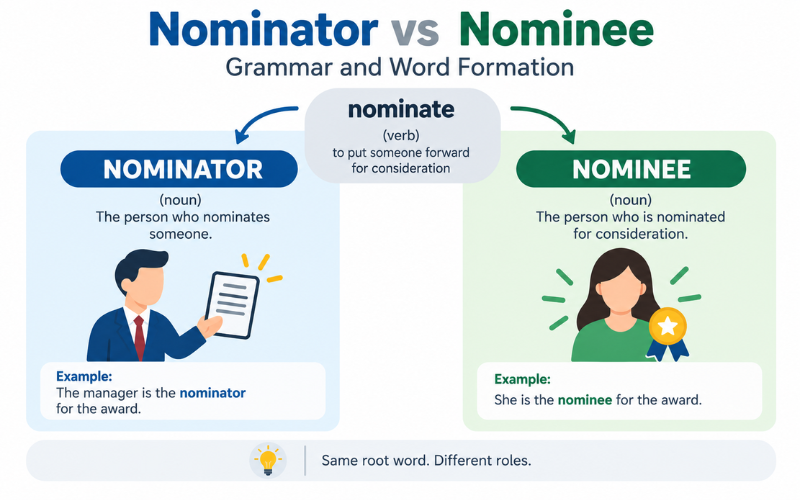
The words nominator and nominee come from the same root, but they represent different grammatical roles.
The base verb is:
nominate
From it, we get:
nominator — the person who nominates
nominee — the person who is nominated
This can be a useful memory aid.
Words ending in -or often identify a person who performs an action, such as:
- Creator
- Instructor
- Operator
- Donor
- Nominator
Words ending in -ee can often identify someone who receives or experiences an action, such as:
- Employee
- Interviewee
- Trainee
- Nominee
English has many exceptions, so this is not an absolute grammar rule. Still, it is a useful shortcut for remembering the difference between these two particular words.
Nominator vs Nominee vs Nomination
Three related terms are often confused:
Nominator
The person or organization that makes the nomination.
Nominee
The person or entity being nominated.
Nomination
The act, recommendation, or formal submission through which someone is put forward.
For example:
Sarah submitted a nomination for David.
Sarah is the nominator.
David is the nominee.
The submission itself is the nomination.
A useful memory trick is:
Nominator = who
Nominee = who is being considered
Nomination = what is submitted or done
This distinction can be especially useful when completing formal forms.
Nominator vs Nominee vs Nominate
These related words have different grammatical functions.
| Word | Part of Speech | Meaning |
| Nominate | Verb | To put someone forward for consideration |
| Nominator | Noun | The person or organization that nominates |
| Nominee | Noun | The person or entity that is nominated |
| Nomination | Noun | The act or submission of nominating |
Examples
Nominate:
I will nominate John.
Nominator:
I am John’s nominator.
Nominee:
John is the nominee.
Nomination:
My nomination was submitted yesterday.
Each word has a different job in the sentence.
What Does a Nominator Usually Do?
The responsibilities of a nominator depend on the specific process.
A nominator may need to:
- Identify a suitable candidate
- Check the candidate’s eligibility
- Complete a nomination form
- Provide the nominee’s details
- Explain why the nominee deserves consideration
- Describe relevant achievements
- Submit supporting evidence
- Write a recommendation
- Provide contact information
- Meet the submission deadline
- Respond to follow-up questions
Not every nomination requires all of these steps.
Some nomination systems may ask for only a name and short explanation. Others may require a detailed nomination package.
What Does a Nominee Usually Do?
A nominee’s responsibilities also vary.
Depending on the program, a nominee may need to:
- Confirm eligibility
- Accept the nomination
- Complete an application
- Provide supporting documents
- Answer questions
- Supply a biography
- Provide references
- Participate in an interview
- Confirm information
- Meet additional deadlines
In other cases, the nominee may not need to do anything after being nominated.
For example, an award organization might notify a person that they have been nominated and handle the remainder of the selection process itself.
Does a Nominee Have to Accept a Nomination?
Not necessarily.
Whether acceptance is required depends on the rules of the particular program.
Some organizations allow nominations without prior approval. Others require the nominee to confirm participation before the nomination can move forward.
Therefore, you should not automatically assume:
“Someone nominated me, so I am officially a candidate.”
The nomination may still need to be verified, accepted, approved, or screened.
The official rules are the best source for determining what happens next.
Does Being Nominated Mean You Are Qualified?
Not necessarily.
A nomination means that someone has put a person forward for consideration. It does not automatically prove that the nominee satisfies every eligibility requirement.
An organization may review qualifications after receiving a nomination.
For example, a program may have requirements relating to:
- Professional experience
- Membership
- Location
- Academic status
- Age
- Service
- Employment
- Previous achievements
If the nominee does not meet the rules, the nomination may not proceed.
Therefore:
Nomination is not the same as eligibility.
Does Being Nominated Mean You Will Win?
No.
A nominee is simply a person being considered.
There may be:
- Many nominees
- A shortlist
- Several finalists
- One final recipient
For example:
Twenty people are nominated for an award, five become finalists, and one person wins.
All twenty are nominees.
The five are finalists.
The one selected person is the winner.
This is why nominee should never automatically be interpreted as winner.
Nominator vs Nominee: Who Has More Authority?
Neither word automatically indicates greater authority.
The terms describe roles, not rank.
A senior manager may nominate a junior employee.
A junior employee may nominate a senior manager.
A teacher may nominate a student.
A student may nominate a teacher.
A colleague may nominate another colleague.
The organization’s rules determine who is allowed to nominate and who can be nominated.
Therefore, being a nominator does not automatically mean having more authority than the nominee.
Nominator vs Nominee: Who Chooses Whom?
Generally, the nominator proposes the nominee.
However, the nominator usually does not have the final decision.
For example:
- A manager nominates an employee.
- A committee reviews the nomination.
- The committee selects finalists.
- The organization chooses a recipient.
The nominator begins or supports the process, but another body may make the final decision.
This is why it would be misleading to say:
“The nominator selected the winner.”
unless the nominator actually has that authority.
A more precise sentence would be:
“The manager nominated the employee, and the selection committee later chose the winner.”
Nominator vs Nominee: Practical Comparison
| Question | Nominator | Nominee |
| Who starts the nomination? | Usually the nominator | Usually not |
| Who is recommended? | Usually not | Yes |
| Who may write the nomination statement? | Often | Sometimes |
| Who may need to accept? | Usually no | Sometimes |
| Who is evaluated? | Not usually | Yes |
| Who may eventually win? | Not because of nomination itself | The nominee may |
| Can they be the same person? | Yes, through self-nomination | Yes |
| Is the role permanent? | No | No |
| Does nomination equal selection? | No | No |
This table shows why the two terms should not be used interchangeably.
Common Misconceptions About Nominators and Nominees
Misconception 1: The Nominee Is the Winner
This is incorrect.
A nominee is someone being considered.
The nominee may eventually win, but the nomination itself does not guarantee victory.
Misconception 2: The Nominator Receives the Award
Usually, the award or recognition is intended for the selected nominee.
The nominator may be acknowledged for making the nomination, but this depends on the particular program.
Misconception 3: A Nominee Always Nominates Someone Else
Not necessarily.
Self-nomination can make one person both the nominator and nominee.
Misconception 4: Every Nomination Requires Permission
Not always.
Some organizations require the nominee’s consent, while others allow people to be nominated without prior approval.
Misconception 5: Nominator Means Sponsor
Not necessarily.
A nominator puts someone forward for consideration.
A sponsor may provide funding, resources, organizational support, or advocacy.
One person can perform both roles, but the words do not mean the same thing.
Misconception 6: Nominee Means Applicant
Not always.
An applicant is generally someone who applies.
A nominee is someone who has been put forward through a nomination.
Some programs combine these processes, but the concepts remain distinct.
Nominator vs Nominee in Different Contexts
The following table shows how the terms can appear in different situations.
| Context | Nominator | Nominee |
| Employee award | Manager or coworker | Employee |
| Student award | Teacher or administrator | Student |
| Scholarship | Teacher, institution, or authorized person | Student |
| Professional honor | Colleague or association | Professional |
| Election | Eligible person, group, or party | Candidate |
| Community award | Community member or organization | Individual or group |
| Fellowship | Referrer, institution, or authorized person | Candidate |
| Self-nomination | Candidate | Same candidate |
| Team recognition | Manager or colleague | Team |
The process may change, but the central relationship remains the same.
Why the Difference Between Nominator and Nominee Matters
You may wonder why these terms need to be distinguished so carefully.
In casual conversation, confusing them may not cause a serious problem. But in formal situations, using the wrong word can create confusion.
Applications
An application or nomination form may have separate fields for:
Nominator Information
and:
Nominee Information
Entering the wrong person’s information into the wrong section can create administrative confusion.
Awards
Award organizations may need to know who recommended the candidate and who is being considered.
Professional References
The person supporting or recommending a candidate and the candidate themselves may have different roles.
Elections
Election processes can involve formal nomination requirements, making accurate terminology particularly important.
Workplace Recognition
Human resources teams may track nominators, nominees, finalists, and recipients separately.
The distinction may therefore be small in everyday language but important in formal documentation.
How to Remember Nominator vs Nominee
There are several simple ways to remember the difference.
Focus on the Action
Remember:
Nominator = does the nominating
Nominee = gets nominated
The nominator nominates the nominee.
Use the Arrow
Visualize:
Nominator → Nominee
The action moves from the person making the nomination toward the person being nominated.
Ask Two Questions
When you are unsure, ask:
Who nominated someone?
That is the nominator.
Who was nominated?
That is the nominee.
Remember a Simple Sentence
Jane nominated Mark.
Jane = nominator.
Mark = nominee.
If you remember this sentence, you can usually work out the meaning of both terms.
Nominator vs Nominee: Sentence Examples
Seeing the words in complete sentences can make their meanings more natural.
Example 1
The committee asked the nominator to provide additional information about the candidate.
The nominator is the person who submitted the nomination.
Example 2
The nominee was informed that she had been selected as a finalist.
The nominee is the person being considered.
Example 3
Each nominator may submit a nomination.
The nominator is the person who submits the nomination.
Example 4
The nominee must meet the eligibility requirements.
The nominee is the person being evaluated.
Example 5
The organization contacted both the nominator and nominee.
This sentence shows that the two roles can involve different people in the same process.
Nominator vs Nominee in Formal Writing
Using the correct term is particularly important in professional and formal writing.
Suppose someone else submitted a nomination for Sarah.
It would be inaccurate to write:
“Sarah submitted the nomination.”
if Sarah was only the person being nominated.
A more precise sentence would be:
“The nominator submitted the nomination on behalf of Sarah, the nominee.”
Similarly, instead of saying:
“John recommended Sarah and she was the nominator.”
if John actually submitted the nomination, write:
“John was the nominator, and Sarah was the nominee.”
Precise terminology can be especially useful in:
- Official forms
- Award applications
- Scholarship applications
- Recommendation letters
- Institutional records
- Election documents
- Professional correspondence
- Workplace recognition programs
Nominator vs Nominee in a Recommendation Letter
A recommendation letter can involve several different roles.
Suppose a professor writes a letter supporting a student’s nomination for an academic award.
If the professor is formally submitting the nomination, the professor may be the nominator.
The student is the nominee.
The award committee is the reviewing body.
But suppose another person submits the official nomination and simply asks the professor to provide a supporting letter.
In that situation, the professor may be a recommender rather than the formal nominator.
This distinction matters because not everyone who supports a nomination is necessarily the official nominator.
Nominator vs Recommender
The words nominator and recommender are related, but they are not always interchangeable.
A recommender is someone who recommends or supports a person.
A nominator is specifically the person or organization that formally makes or submits a nomination when the process uses that role.
For example:
The department chair nominated Maria and asked Professor Lee to provide a recommendation letter.
In this situation:
- Department chair = nominator
- Maria = nominee
- Professor Lee = recommender
One person can perform multiple roles, but the terms themselves have different meanings.
Nominator vs Sponsor
A sponsor is also different from a nominator.
A sponsor may:
- Provide financial support
- Provide resources
- Offer organizational backing
- Promote a person or project
- Support an initiative
A nominator’s central function is to put someone forward for consideration.
For example, a company may sponsor an award event without nominating any particular person.
Likewise, someone may nominate a person without providing financial support.
Therefore:
Nominator ≠ Sponsor
unless the same individual or organization happens to perform both roles.
Nominator vs Referrer
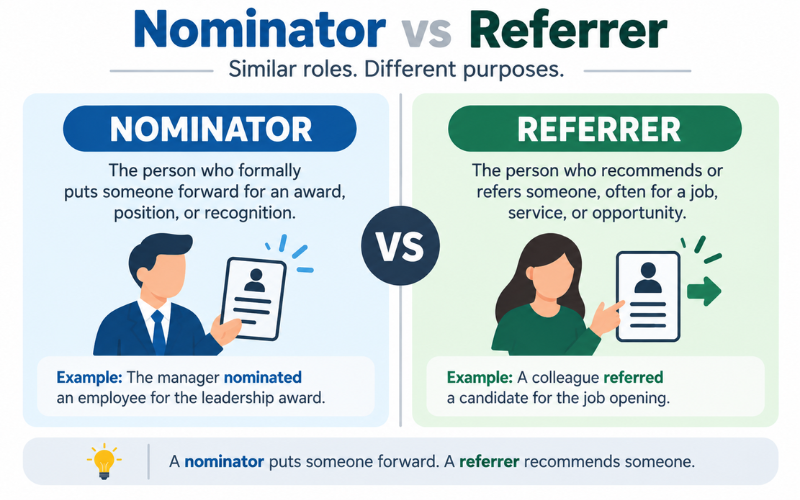
A referrer is someone who refers another person.
Referrals commonly occur in:
- Recruitment
- Professional networking
- Business development
- Customer referrals
- Service recommendations
A nomination is more specific.
For example:
Ali referred Sara for a job opening.
Ali may be called a referrer.
But if an organization formally asks employees to nominate coworkers for an award and Ali submits Sara’s name, Ali is the nominator.
The correct word depends on the process being described.
Nominator vs Nominee: What Happens After Nomination?
Once a nomination has been submitted, several things can happen.
The Nominee Becomes a Finalist
The selection body may reduce the number of candidates.
The Nominee Wins
The nominee may ultimately be selected as the recipient.
The Nominee Is Not Selected
The person may remain a nominee without receiving the award.
The Nominee Withdraws
If the rules allow it, the nominee may withdraw from consideration.
The Nominee Is Found Ineligible
The organization may determine that the person does not meet the requirements.
The Nominee Advances to Another Stage
Some programs have multiple rounds of review.
This is why nomination should be viewed as part of a selection process, rather than as the final result.
What Is a Nomination Form?
A nomination form is a document or online submission used to put a person or entity forward for consideration.
Depending on the organization, it may request:
- Nominator’s name
- Nominator’s contact information
- Nominee’s name
- Nominee’s contact information
- Organization
- Award or position
- Explanation of qualifications
- Supporting evidence
- References
- Consent
- Additional documentation
A form may have two separate sections:
Nominator Information
This section normally asks for information about the person submitting the nomination.
Nominee Information
This section normally asks for information about the person being nominated.
Understanding the difference between the two words helps prevent mistakes when completing these forms.
What Should a Nominator Include in a Nomination?
There is no single formula for every nomination.
However, a useful nomination generally explains why the nominee deserves consideration.
Depending on the criteria, the nominator may include:
- Specific achievements
- Relevant contributions
- Leadership examples
- Professional accomplishments
- Community contributions
- Impact on others
- Supporting evidence
- Examples that directly match the award criteria
A vague statement such as:
“She is an excellent person.”
may not explain enough.
A stronger nomination describes what the nominee actually accomplished and connects those accomplishments to the criteria.
The official requirements should always take priority over general advice.
What Should a Nominee Do After Being Nominated?
The nominee should first review the program’s rules.
Depending on the process, the nominee may need to:
- Confirm eligibility.
- Check whether acceptance is required.
- Provide requested documents.
- Complete an application.
- Meet deadlines.
- Answer follow-up questions.
- Confirm that submitted information is accurate.
If the program does not require any action, the nominee may simply wait for the outcome.
There is no universal requirement that applies to every nomination.
Can Someone Be Nominated More Than Once?
Yes, depending on the rules.
A person may potentially receive multiple nominations from:
- Different nominators
- Different organizations
- The same nominator in different years
- Different categories
Some programs may have restrictions on repeat nominations or duplicate submissions.
Receiving multiple nominations also does not automatically mean that the person will win.
Can There Be Multiple Nominators?
Yes.
Some nomination systems allow multiple people or organizations to nominate the same person.
For example, nominations may come from:
- Coworkers
- Managers
- Professional associations
- Community members
- Institutions
In other cases, one person may submit the official nomination while several other people provide supporting letters.
The rules determine who is officially recorded as the nominator.
Can There Be Multiple Nominees?
Yes.
Many awards and selection processes have multiple nominees.
For example:
Ten people were nominated for the annual award.
All ten are nominees.
The organization may later reduce the group to a shortlist or group of finalists before selecting the final recipient.
Therefore, nominee does not imply that only one person is being considered.
Nominator vs Nominee: Is One Better?
Neither term is inherently better.
They simply describe different roles.
The nominator is the person making the nomination.
The nominee is the person being considered.
If you submit the nomination:
You are the nominator.
If someone else puts your name forward:
You are the nominee.
If you nominate yourself and self-nomination is allowed:
You can be both.
The terms do not represent higher or lower status.
Which Role Is More Important: Nominator or Nominee?
That depends on the stage of the process.
The nominee is generally central to the final decision because their qualifications are being evaluated.
The nominator is important because they initiate or formally support the nomination.
In a typical award process:
- The nominator presents the case.
- The nominee provides or represents the qualifications being evaluated.
- The selection body makes the decision.
Each role serves a different purpose.
Nominator vs Nominee: A Real-World Scenario
Imagine that a university creates an annual Teaching Excellence Award.
Emma is a student who believes Professor Daniel has made an exceptional contribution to teaching.
Emma submits a nomination describing Daniel’s work.
Emma
Emma submitted the nomination.
Emma = nominator
Professor Daniel
Daniel is the person being considered.
Daniel = nominee
University Award Committee
The committee reviews the nominations.
Committee = selection body
If Daniel Wins
If the committee selects Daniel, he becomes the award recipient or winner.
He remains the person who was originally nominated.
This demonstrates an important distinction:
Nominee describes his role in the nomination process.
Winner describes the result of the selection process.
Nominator vs Nominee in Self-Nomination
Self-nomination can initially seem confusing because one person occupies both roles.
Suppose a fellowship permits applicants to nominate themselves.
James completes the nomination form and enters his own name.
Who performed the nomination?
James.
Who was nominated?
James.
Therefore:
James = nominator
and:
James = nominee
There is no contradiction because the two terms describe different roles.
One describes who performed the action.
The other describes who received the action.
Why “Nominator” and “Nominee” Are Sometimes Confusing
The confusion is understandable because both words come from the same root.
Both are related to:
Nominate → Nomination → Nominator → Nominee
People may remember that the terms are connected but forget which one refers to the person performing the action.
Another reason is that everyday conversation often focuses on the person being recognized.
For example:
“She was nominated for the award.”
This tells us that she is the nominee, but it does not tell us who nominated her.
If the identity of the person who submitted the nomination matters, ask:
“Who nominated her?”
The answer identifies the nominator.
Nominator vs Nominee: The Passive Voice Test
English sentence structure can provide another useful way to identify the two roles.
Consider the active sentence:
Mark nominated Lisa.
Mark performs the action.
Mark = nominator
Lisa is the person being nominated.
Lisa = nominee
Now change the sentence to passive voice:
Lisa was nominated by Mark.
Lisa remains the nominee.
Mark remains the nominator.
The sentence structure has changed, but the roles have not.
This makes active and passive sentences a useful test when you are unsure.
Nominator vs Nominee: Common Sentence Patterns
Several sentence patterns make the difference easy to identify.
“X nominated Y.”
X = nominator
Y = nominee
“Y was nominated by X.”
Y = nominee
X = nominator
“The nomination was submitted by X.”
X = likely the nominator, depending on the rules.
“Y received a nomination.”
Y = nominee.
“X submitted Y’s nomination.”
X = nominator.
Y = nominee.
“Y nominated himself.”
Y = both nominator and nominee if self-nomination is permitted.
These patterns are useful when reading forms, applications, announcements, and official documents.
Nominator vs Nominee: Common Mistakes
Mistake 1: Saying the Nominee Nominated Someone
This is not necessarily wrong, but it depends on the sentence.
If John nominated himself, then John can be both.
But if Sarah nominated John, you should say:
“John was nominated by Sarah.”
not:
“John was the nominator.”
Mistake 2: Calling the Person Being Recommended the Nominator
If Sarah recommends John, Sarah is the nominator.
John is the nominee.
The person receiving the recommendation is not automatically the nominator.
Mistake 3: Calling Every Supporter the Nominator
Someone who writes a recommendation letter or provides a reference may support a nomination without being the official nominator.
The program’s rules determine who has the formal role.
Mistake 4: Treating Nomination as Selection
Being nominated does not necessarily mean being selected.
Selection may happen later.
Mistake 5: Treating Nomination as Winning
A nominee may not win.
The nomination simply puts the person forward for consideration.
Nominator vs Nominee: Similarities
Although the words have different meanings, they are closely related.
Both Are Connected to a Nomination
The two roles exist within or around the same nomination process.
Both Can Refer to People
The most common use involves individuals.
Both Can Sometimes Refer to Organizations
Depending on the context, organizations can nominate or be nominated.
Both Can Appear on Official Forms
Nomination forms may collect information about both parties.
Both Can Be Part of the Same Process
One nomination naturally connects the nominator and nominee.
One Person Can Be Both
This can happen when self-nomination is allowed.
Nominator vs Nominee: Benefits and Responsibilities
The terms themselves do not have advantages or disadvantages. They simply describe roles.
However, the roles may involve different experiences.
Possible Benefits for a Nominator
A nominator may have the opportunity to:
- Recognize a deserving person
- Support a colleague
- Highlight someone’s achievements
- Advocate for professional recognition
- Help bring attention to an accomplishment
Possible Responsibilities for a Nominator
The nominator may need to:
- Gather information
- Follow nomination rules
- Meet deadlines
- Provide accurate details
- Write a nomination statement
- Submit supporting material
Possible Benefits for a Nominee
A nominee may:
- Receive recognition
- Gain visibility
- Be considered for an opportunity
- Become a finalist
- Potentially receive an award or honor
Possible Responsibilities for a Nominee
Depending on the program, the nominee may need to:
- Confirm eligibility
- Accept the nomination
- Provide documents
- Complete forms
- Participate in interviews
- Meet deadlines
The exact benefits and responsibilities depend on the particular nomination system.
Nominator vs Nominee: Which Role Comes First?
Usually, the nominator comes first in the action sequence.
A typical process looks like:
Nominator → Nomination → Nominee → Evaluation → Selection
The nominator performs the nomination.
The nominee is then considered.
However, the nominee may have been identified as a potential candidate before the nomination was formally submitted.
So when we say the nominator “comes first,” we are talking about the formal action, not necessarily when the candidate first became known.
Nominator vs Nominee: Who Receives the Recognition?
Usually, the nominee is the person or entity being considered for the award or recognition.
If the nominee is selected, that person becomes the recipient.
For example:
Sarah nominated David for the award.
If David wins:
David = nominee + winner
Sarah remains:
Sarah = nominator
Some programs may separately recognize the people who submit nominations, but this depends on the rules.
Nominator vs Nominee in Online Forms
Online nomination forms often make the distinction very clear.
A form might contain separate sections.
Nominator Information
This could include:
- Name
- Email address
- Organization
- Relationship to nominee
- Contact details
Nominee Information
This could include:
- Name
- Position
- Organization
- Contact details
- Qualifications
- Achievements
If you are completing a nomination form, do not automatically put your own information into both sections.
You would normally appear in the nominee section only if you are nominating yourself and the rules permit it.
If you want to compare this comparison with other posts check these comparisons Oversight vs Oversite and Tweek vs Tweak
What Does “Nominated By” Mean?
The phrase “nominated by” generally identifies the person or organization that made the nomination.
For example:
Sarah was nominated by her manager.
This means:
- Sarah = nominee
- Her manager = nominator
The phrase “by” is therefore a useful clue when identifying the nominator.
What Does “Nominated For” Mean?
The phrase “nominated for” usually identifies the award, position, honor, or opportunity for which the person is being considered.
For example:
David was nominated for the Employee Excellence Award.
Here:
- David = nominee
- Employee Excellence Award = recognition
- The person who submitted David’s nomination = nominator
“Nominated for” tells you what the person is being considered for, rather than who submitted the nomination.
Nominated By vs Nominated For
These phrases are easy to distinguish once you know what each one identifies.
Nominated By
This tells you who made the nomination.
Maria was nominated by John.
John = nominator.
Nominated For
This tells you what Maria is being considered for.
Maria was nominated for the leadership award.
Maria = nominee.
Both in One Sentence
You can combine the two:
Maria was nominated by John for the leadership award.
Now the roles are clear:
- John = nominator
- Maria = nominee
- Leadership award = purpose of the nomination
Nominator vs Nominee: Final Comparison
The difference between a nominator and nominee ultimately comes down to the direction of the nomination.
The nominator is the person or organization that takes the action of putting someone forward. The nominee is the person or entity being put forward for consideration.
For example:
Lisa nominated Mark for an award.
Lisa is the nominator because she made the nomination.
Mark is the nominee because he was nominated.
The award committee may then evaluate Mark alongside other nominees. Mark might become a finalist, win the award, or not be selected. Those outcomes do not change the basic meaning of the two terms.
The simplest formula to remember is:
Nominator → makes the nomination → Nominee
The terms are related, but they are not interchangeable. A nominator performs the action, while a nominee is the person or entity being considered. If self-nomination is allowed, one person can occupy both roles.
If it is helpful for you and want more free guides then here we have more for you:
FAQs
What is the difference between a nominator and a nominee?
The nominator is the person or organization that makes or submits a nomination. The nominee is the person or entity being nominated for consideration.
For example, if Sarah nominates John for an award, Sarah is the nominator and John is the nominee.
Is the nominee the person who nominates someone?
No. Normally, the nominee is the person being nominated.
The person who nominates someone is the nominator.
The exception is self-nomination, where one person can be both.
Can a person be both the nominator and nominee?
Yes, if self-nomination is permitted.
For example:
David nominated himself.
David is both the person making the nomination and the person being nominated.
Does being a nominee mean you won?
No.
A nominee is simply someone who has been put forward for consideration. The nominee may become a finalist or winner, but nomination itself does not guarantee selection.
Is a nominator the same as a recommender?
Not necessarily.
A nominator formally makes or submits a nomination. A recommender may provide a supporting recommendation or reference.
One person can perform both roles, but the terms do not automatically mean the same thing.
Can an organization be a nominator?
Yes.
Depending on the rules, an organization, institution, association, committee, or other group may nominate a person or entity.
Can an organization be a nominee?
Yes, in some recognition programs.
Organizations, teams, institutions, projects, and other entities may sometimes be nominated.
Does a nominee have to accept the nomination?
Not always.
Some programs require the nominee to accept or confirm participation, while others allow nominations without prior acceptance.
The specific program’s rules determine the requirement.
Who chooses the winner, the nominator or nominee?
Usually neither.
A separate selection committee, organization, voting body, or authorized decision-maker may choose the recipient.
The nominator generally puts forward the candidate, while the nominee is evaluated.
Can there be multiple nominators for one nominee?
Yes.
Some programs allow multiple people or organizations to nominate the same candidate. Other programs may have rules concerning duplicate nominations or supporting nominations.
Can there be multiple nominees?
Yes.
Awards and other competitive selection processes commonly have multiple nominees.
A smaller group may later become finalists before one person or entity is selected.
What is the difference between a nominee and a candidate?
A nominee is specifically someone who has been nominated. A candidate is someone being considered for a position or opportunity.
The terms can overlap, but nominee emphasizes the nomination process.
What is the difference between nomination and nominee?
A nomination is the act or submission of putting someone forward.
A nominee is the person or entity being put forward.
For example:
Sarah submitted a nomination for John.
Sarah is the nominator, the submission is the nomination, and John is the nominee.
What is the easiest way to remember nominator vs nominee?
Remember:
Nominator = nominates
Nominee = nominated
Another simple sentence is:
The nominator nominates the nominee.
That is the easiest way to keep the two terms separate.
Conclusion
Understanding the nominator vs nominee differences becomes easy when you focus on who performs the action and who receives it. The nominator is the person or organization that makes or submits the nomination, while the nominee is the person or entity being put forward for consideration.
For example, if Sarah nominates John for an award, Sarah is the nominator and John is the nominee. If John is eventually selected, he becomes the winner or recipient, but Sarah remains the person who made the nomination.
These terms can appear in awards, scholarships, elections, professional recognition programs, workplace nominations, fellowships, and many other situations. A nomination does not automatically mean that the nominee is qualified, selected, or guaranteed to win. It simply means that someone has put that person or entity forward for consideration.
The easiest rule to remember is “the nominator nominates, while the nominee is nominated.” If self-nomination is permitted, one person can be both. Once you understand this simple relationship, it becomes much easier to use nominator, nominee, nominate, and nomination correctly in forms, applications, professional writing, and everyday conversation.
For More Info Visit: Meaningscope
