
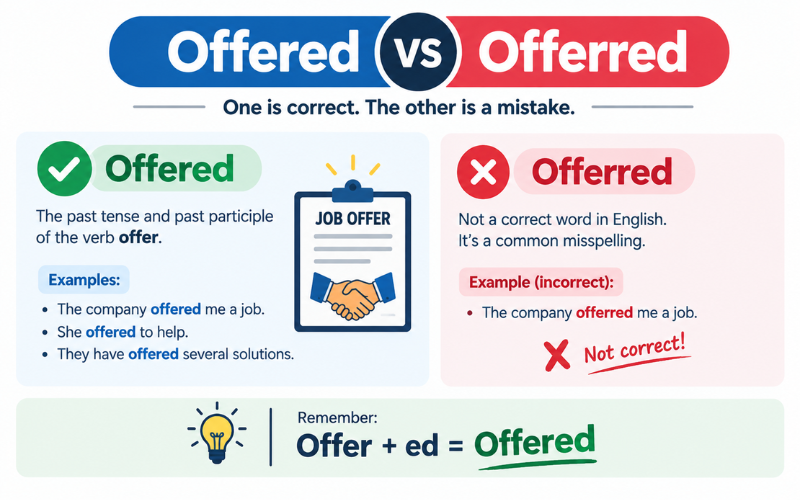
Offered vs offerred is a common spelling question because the word offer ends in a consonant before the past-tense ending -ed, and it can be tempting to double the final letter. However, only one of these spellings is correct in standard English.
The correct spelling is offered.
Offerred is a misspelling and should not be used in standard English writing.
For example:
The company offered me a new position.
Not:
The company offerred me a new position.
The confusion happens because many English verbs double their final consonant before adding a suffix. For example, stop becomes stopped, and plan becomes planned. However, the spelling rules do not require doubling the final r in offer.
In this guide, we will explain the difference between offered and offerred, why offered is correct, how to use it in sentences, its grammar and word formation, common mistakes, pronunciation, related words, and easy ways to remember the correct spelling.
Offered vs Offerred
The answer is simple:
Offered ✅ = correct spelling
Offerred ❌ = incorrect spelling
The verb offer forms its past tense and past participle by adding -ed:
offer → offered
The r is not doubled.
Quick Comparison
| Word | Correct? | Meaning |
| offered | ✅ Yes | Past tense and past participle of offer |
| offerred | ❌ No | Common misspelling of offered |
For example:
She offered to help me.
The word offered means that she made an offer or expressed willingness to do something.
What Does Offered Mean?
Offered is the past tense and past participle of the verb offer.
The verb offer can have several related meanings depending on context.
It can mean:
- To present something for someone to accept
- To provide something
- To suggest something
- To express willingness to do something
- To make something available
- To propose a price
- To give someone an opportunity
For example:
The store offered a discount.
Here, offered means the store made a discount available.
Another example:
He offered to drive me home.
Here, offered means he expressed willingness to drive the person home.
What Does Offerred Mean?
Offerred is not the standard spelling of the past tense of offer.
It is a common spelling mistake caused by incorrectly doubling the final r.
The correct form is:
offer → offered
Not:
offer → offerred
Therefore, if you are writing a sentence such as:
The company offered him a job.
you should never write:
The company offerred him a job.
The second version contains an unnecessary extra r.
Why Is Offered Correct and Offerred Incorrect?
The spelling follows the normal formation of the past tense of offer.
The base verb is:
offer
To form the simple past tense, add:
-ed
This gives:
offer + ed = offered
There is no need to add another r.
Word Formation
The spelling can be broken down as:
offer + ed = offered
The final letters of the base verb remain:
offer
Then -ed is added:
offered
This results in two f’s and one r before the ed ending:
o-f-f-e-r-e-d
The incorrect spelling offerred contains an extra r.
Why Do People Write Offerred?
There are several reasons people may accidentally write offerred.
Confusion About Double-Consonant Rules
English has many verbs that double a final consonant when adding -ed.
For example:
- Stop → stopped
- Plan → planned
- Prefer → preferred
- Admit → admitted
Because of these examples, writers may assume that offer should become offerred.
It does not.
The Word Looks Like It Might Need a Double R
Since offer already ends with r, adding -ed can visually feel unusual:
offer + ed
Some writers instinctively add another r:
offer + red
But this is incorrect.
Pronunciation Does Not Make the Spelling Obvious
When spoken, offered can sound like it contains a strong r sound. Someone who has mostly heard the word rather than seen it written may spell it incorrectly.
Offered vs Offerred Spelling
The easiest visual comparison is:
Correct
OFFERED
Incorrect
OFFERRED
The difference is one extra r.
Remember:
offer + ed = offered
not:
offer + red = offerred
This is the most important spelling rule to remember.
Offered as the Past Tense of Offer
Offered is the simple past form of offer.
For example:
She offered me some coffee.
The company offered him a position.
They offered a reasonable price.
He offered to help with the project.
These actions happened in the past.
Present vs Past
The present form is:
offer
The past form is:
offered
For example:
The company offers flexible working hours.
Past:
The company offered flexible working hours.
The spelling changes from offer to offered, not offerred.
Offered as a Past Participle
Offered is also the past participle of offer.
It can be used with auxiliary verbs such as has, have, and had.
Examples:
The company has offered me a position.
They have offered several solutions.
She had offered to help before I asked.
It can also appear in passive constructions:
He was offered a job.
They were offered a discount.
In all these sentences, the correct form is offered.
Offered in Different Sentence Structures
The word offered can be used in many different sentence patterns.
Offered + Object
The company offered him a job.
Here, the company made a job available to him.
Offered + Something + to Someone
She offered some advice to her friend.
Here, advice is what was offered.
Offered + to + Verb
He offered to help us.
This means he expressed willingness to help.
Offered + Something + for a Price
They offered $500 for the used computer.
Here, offered means proposed a particular price.
Was Offered
I was offered a new position.
This is a passive construction.
Common Uses of Offered
The word offered appears in many everyday situations.
Offered a Job
She was offered a job at the company.
This means the company presented her with an employment opportunity.
Offered Help
He offered to help me with the boxes.
This means he volunteered to help.
Offered Advice
The teacher offered useful advice.
This means the teacher provided or gave advice.
Offered a Discount
The store offered a discount to customers.
This means the store made a lower price available.
Offered a Solution
The team offered a solution to the problem.
This means the team suggested or provided a possible solution.
Offered an Explanation
The manager offered an explanation for the delay.
This means the manager provided an explanation.
Offered vs Offerred in Everyday Examples
Here are some examples using the correct spelling.
The company offered me a position.
She offered to help with the project.
The restaurant offered a special menu.
He offered his seat to an elderly passenger.
They offered us a better price.
The teacher offered some helpful advice.
The hotel offered free breakfast.
The manager offered an explanation.
Every example uses offered, never offerred.
Offered vs Offerred in Formal Writing
Correct spelling is particularly important in formal writing.
You may use offered in:
- Business emails
- Job applications
- Academic writing
- Reports
- Contracts
- News articles
- Website content
- Professional correspondence
For example:
The organization offered financial assistance to eligible applicants.
Writing offerred instead can make an otherwise professional sentence look careless.
Formal Writing Example
Correct:
The company offered the candidate a permanent position.
Incorrect:
The company offerred the candidate a permanent position.
The first sentence is grammatically and orthographically correct.
Offered vs Offerred in Business English
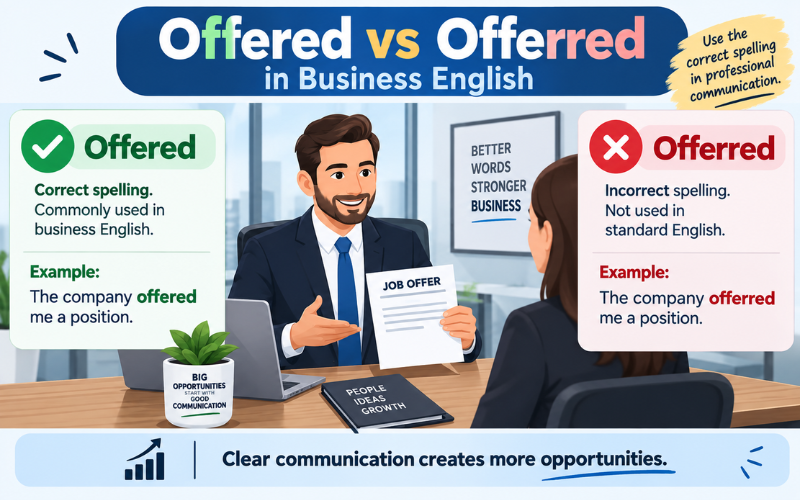
Offered is very common in business communication.
Examples include:
The company offered a competitive salary.
The supplier offered a lower price.
The bank offered several financing options.
The employer offered flexible working hours.
The business offered customers a seasonal discount.
In each case, offered is the correct spelling.
Offered vs Offerred in Job and Employment Contexts
Job-related writing frequently uses the word offered.
Examples:
I was offered a new position.
The company offered me a full-time job.
She was offered an interview.
He was offered a promotion.
They offered him a higher salary.
A particularly common expression is:
job offer
When the action is described in the past:
The company offered him a job.
Offered vs Offerred in Sales and Shopping
The word offered is also common when discussing products, prices, and promotions.
For example:
The store offered a 20% discount.
The website offered free shipping.
The retailer offered several payment options.
The seller offered a lower price.
Again, the spelling is:
offered
not:
offerred
Offered vs Offerred in Customer Service
Customer service writing frequently uses offered.
Examples:
The company offered the customer a replacement.
The hotel offered a refund.
The airline offered another flight.
The support team offered a solution.
These examples show how flexible the word can be.
Offered vs Offerred in Academic Writing
In academic writing, offered can mean provided, suggested, or presented.
For example:
The study offered several possible explanations.
The researcher offered a different interpretation.
The article offered useful insights into the topic.
Here, offered does not necessarily mean giving something physical. It can mean presenting an idea or explanation.
Offered vs Offerred in Passive Voice
The word offered is frequently used in passive constructions.
For example:
She was offered a scholarship.
The students were offered additional support.
He was offered a promotion.
Customers were offered several payment options.
The structure is:
subject + was/were + offered
This is another important use of the word.
Offered vs Offerred With “To”
A common grammatical structure is:
offered to + verb
For example:
She offered to help.
He offered to drive us home.
They offered to repair the computer.
I offered to pay for dinner.
This construction means someone expressed willingness to perform an action.
Correct Structure
offered to help ✅
offered to drive ✅
offered to explain ✅
The word should always be spelled offered.
Offered vs Offerred With “That”
Another structure is:
offered that
However, this construction is less common in everyday English and can sound formal or unnatural depending on the sentence.
More natural alternatives may include:
She offered an explanation.
or:
She suggested that we wait.
The correct spelling remains offered whenever the word is used.
Offered vs Gave
The words offered and gave can sometimes appear in similar contexts, but they do not always mean exactly the same thing.
Offered
Offered suggests that something was presented or made available for someone to accept.
He offered me some water.
This does not necessarily mean I accepted it.
Gave
Gave usually indicates that something was actually transferred to another person.
He gave me some water.
This suggests that the person actually gave the water to me.
This distinction can be useful when choosing the most precise word.
Offered vs Suggested
Offered and suggested can overlap when discussing ideas.
For example:
She offered a possible solution.
She suggested a possible solution.
Both can mean she presented an idea for consideration.
However, offer has a broader range of meanings and can also describe giving, providing, proposing a price, or expressing willingness.
Offered vs Proposed
In some contexts, offered and proposed can also be related.
For example:
The company offered a new solution.
The company proposed a new solution.
Both can describe presenting an idea.
However, proposed often emphasizes a formal suggestion or plan, while offered can be broader.
Why “Offerred” Looks Correct to Some People
English spelling contains many patterns involving doubled consonants.
For example:
- Stop → stopped
- Shop → shopped
- Plan → planned
- Refer → referred
- Prefer → preferred
This can make offerred look believable.
However, the spelling pattern depends on the specific word and its pronunciation, stress, and spelling rules.
For offer, the standard form is simply:
offered
The r is not doubled.
Offered vs Preferred
One especially useful comparison is offered vs preferred.
Both words end in -er, but their past forms are spelled differently:
offer → offered
prefer → preferred
Why?
The spelling rules for doubling a final consonant are not identical for every word ending in a consonant. In preferred, the final consonant is doubled in the standard spelling. In offered, it is not.
Therefore, do not use preferred as a model for spelling offered.
Offered vs Referred
Another useful comparison is:
offer → offered
but:
refer → referred
This is a common source of confusion.
Correct:
She offered help.
Correct:
She referred me to a specialist.
Incorrect:
She offerred help.
The two verbs may look similar because they both end in -er, but their past-tense spellings differ.
Offered vs Offerred: Pronunciation
The correct word offered is commonly pronounced approximately:
OFF-erd
It generally has two syllables.
The incorrect spelling offerred does not represent a standard alternative pronunciation of the word.
The spelling should therefore be learned as:
offer → offered
rather than trying to create the spelling from pronunciation.
Offered vs Offerred Word Family
Understanding the word family can make the correct spelling easier to remember.
Offer
The base form:
I offer my help.
Offers
The third-person singular present form:
She offers useful advice.
Offering
The present participle or gerund:
The company is offering a discount.
Offered
The past tense and past participle:
The company offered a discount.
Offer
The noun form:
They made an offer.
The word family is:
offer → offers → offering → offered → offer
Notice that none of these forms uses offerred.
Common Mistakes With Offered
Mistake 1: Writing Offerred
Incorrect:
The company offerred me a job.
Correct:
The company offered me a job.
Mistake 2: Adding an Extra R
Incorrect:
She offerred to help.
Correct:
She offered to help.
Mistake 3: Confusing Offered With Referred
Incorrect:
He offerred me to another department.
Depending on the intended meaning, you may need:
He offered me a position in another department.
or:
He referred me to another department.
The two verbs have different meanings.
Mistake 4: Confusing Offered With Offering
Incorrect:
The company has offering me a position.
Correct:
The company has offered me a position.
Or:
The company is offering me a position.
The choice depends on the grammatical structure.
Offered vs Offering
These forms are related but serve different purposes.
Offered
Past tense or past participle:
The company offered me a position.
Offering
Present participle or gerund:
The company is offering me a position.
Compare:
They offered a discount yesterday.
with:
They are offering a discount today.
Offered vs Offer
The difference between these forms is primarily grammatical.
Offer
Present or base form:
I offer my assistance.
Offered
Past tense:
I offered my assistance yesterday.
The correct past form is always offered, not offerred.
Offered in Questions
The word offered can also be used in questions.
Examples:
Did they offer you the job?
What did the company offer you?
Why was he offered the position?
Did she offer to help?
Notice something important: after did, the base form offer is used:
Did they offer…?
not:
Did they offered…?
This is a separate grammar point that can help improve accuracy.
Offered in Negative Sentences
The same rule applies to negative sentences with did not.
Correct:
They did not offer me a refund.
Incorrect:
They did not offered me a refund.
After did not, use the base form offer.
The past-tense form offered is used when there is no auxiliary did carrying the past tense.
Compare:
They offered me a refund.
They did not offer me a refund.
Offered in Conditional Sentences
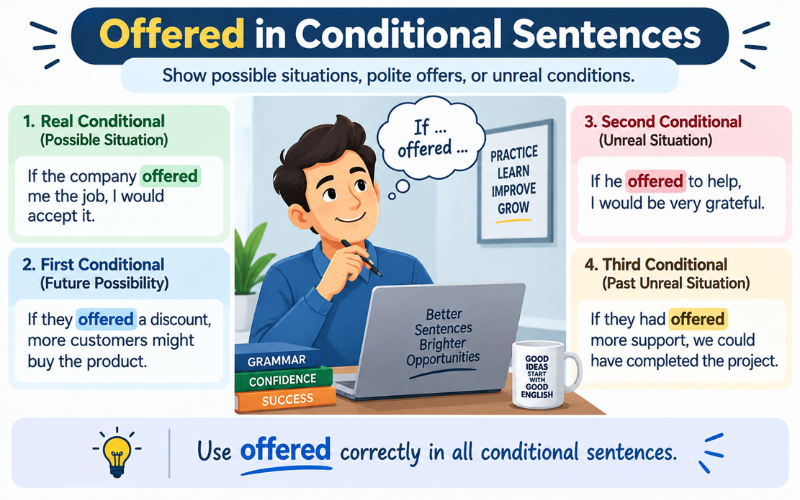
Offered can also appear in conditional contexts.
For example:
If they offered me the position, I would accept it.
Here, the form offered appears in the conditional clause.
Another example:
If the store offered a discount, more customers might buy the product.
Again, the correct spelling is offered.
Offered vs Offerred: Easy Memory Trick
The simplest memory trick is:
Offer + ed = offered
Say it and write it as:
OFFER → OFFERED
Do not add another r.
You can also remember:
There is only one r before -ed in offered.
So:
offered ✅
offerred ❌
A Simple Spelling Test
If you are unsure, remove the -ed ending.
Start with:
offered
Remove -ed:
offer
This gives the correct base verb.
Now add -ed again:
offer + ed = offered
There is no step where an additional r is added.
Offered vs Offerred: Quick Decision Guide
Whenever you see these two spellings, choose:
Offered
Use offered when you mean:
- Presented something
- Provided something
- Suggested something
- Made something available
- Expressed willingness
- Proposed a price
- Gave someone an opportunity
Example:
The company offered several options.
Offerred
Do not use offerred in standard English.
It is simply a misspelling of offered.
Offered vs Offerred Comparison Table
| Feature | Offered | Offerred |
| Standard spelling | ✅ Yes | ❌ No |
| Base verb | Offer | Offer |
| Past tense | Yes | No |
| Past participle | Yes | No |
| Meaning | Past form of offer | Misspelling |
| Correct example | She offered help. | — |
| Extra “r” | No | Yes |
| Used in formal writing | Yes | No |
| Used in standard English | Yes | No |
If it is helpful for you and want more free guides then here we have more for you:
- Manuel vs Manual, Differences, Pronunciation
- Nominato vs Nominee Differences, Meanings And More
- Oversight vs Oversite Differences And Correct Usage
FAQs
Is Offered or Offerred Correct?
Offered is correct. Offerred is a misspelling and should not be used in standard English.
Is Offerred a Word?
No, offerred is not the standard spelling of the past tense of offer. The correct spelling is offered.
Why Is Offered Spelled With One R?
The base verb is offer, and its past tense is formed by adding -ed:
offer + ed = offered
The final r is not doubled.
What Is the Past Tense of Offer?
The past tense of offer is offered.
Example:
She offered me some advice.
What Is the Past Participle of Offer?
The past participle is also offered.
Example:
They have offered several solutions.
Is “Offerred” Ever Correct?
In standard English, no. If you mean the past tense or past participle of offer, use offered.
Why Do People Spell Offered as Offerred?
The mistake usually comes from confusion about English consonant-doubling rules. Words such as stopped, planned, and preferred can make offerred look plausible, but the correct spelling is offered.
How Do You Spell Offered?
The correct spelling is:
O-F-F-E-R-E-D
There are two f’s, one r, and the ending -ed.
What Is the Difference Between Offered and Offerred?
There is no difference in meaning because offerred is simply an incorrect spelling. Offered is the correct form.
Can I Write “She Offerred to Help”?
No. The correct sentence is:
She offered to help.
Is “They Offered Me a Job” Correct?
Yes.
They offered me a job.
This means they presented a job opportunity to you.
Is “Offered to Help” Correct?
Yes.
He offered to help me.
This means he expressed willingness to help.
What Is the Difference Between Offered and Offering?
Offered is the past tense and past participle of offer, while offering is the present participle or gerund.
She offered help yesterday.
She is offering help today.
What Is the Difference Between Offer and Offered?
Offer is the base or present form, while offered is the past tense and past participle.
They offer free delivery.
They offered free delivery last week.
Is “Did They Offered” Correct?
No. After did, use the base form:
Did they offer you a discount?
Not:
Did they offered you a discount?
Is “Did Not Offered” Correct?
No. The correct form is:
They did not offer a refund.
Because did already carries the past tense, the base verb offer follows it.
Is Offered a Verb?
Yes. Offered is a verb form. It is the simple past and past participle of the verb offer.
What Are Some Common Phrases With Offered?
Common expressions include:
- Offered a job
- Offered help
- Offered advice
- Offered a discount
- Offered a solution
- Offered an explanation
- Offered an opportunity
- Offered a refund
- Offered a position
- Offered to help
How Can I Remember the Correct Spelling?
Remember the formula:
offer + ed = offered
Never add an extra r.
Conclusion
The difference between offered and offerred is primarily a matter of correct spelling.
Offered is the correct standard English form. It is the past tense and past participle of offer.
Offerred is an incorrect spelling caused by adding an unnecessary second r.
The correct word formation is:
offer + ed = offered
For example:
The company offered me a job.
She offered to help.
The store offered a discount.
They have offered several solutions.
Never write:
The company offerred me a job.
Instead, remember the simple rule:
OFFER → OFFERED
Once you remember that offer takes -ed without doubling the final r, the offered vs offerred spelling question becomes easy. Whether you are writing a business email, academic article, job application, website content, or everyday message, offered is the form you should use.
For More Info Visit: Meaningscope
