


What Does “Bop” Mean?
The word “bop” is a multifaceted term in English, with meanings that vary widely based on context. It can describe a style of jazz music, refer to a catchy and danceable song, act as slang (sometimes derogatory) for a person, or simply mean a light hit or casual movement. This article explores the different uses of “bop,” including its origins, historical development, key figures, and cultural impact, to offer a thorough understanding of this versatile word.
Related Post: What Does JK Mean? Meaning, History, Uses & Many More
Bop in Music: Bebop Jazz
Bebop, commonly shortened to “bop,” is a groundbreaking jazz genre that emerged in the early 1940s. It represented a departure from the popular big band swing music of the era, focusing instead on fast tempos, complex chord progressions, intricate melodies, and extensive improvisation. Performed by small groups rather than large orchestras, bebop emphasized individual virtuosity and was primarily intended for listening rather than dancing.
Origins of Bebop
The name “bebop” comes from the nonsensical scat syllables singers used to imitate instrumental phrases, such as “be-bop” or “re-bop.” It developed in New York City’s Harlem during late-night jam sessions at venues like Minton’s Playhouse. Musicians gathered there to experiment freely, away from the commercial demands of swing bands. This innovation occurred during World War II, when many young players sought greater artistic expression and reacted against the popularized, dance-focused jazz of the time.
History of Bebop
Bebop’s growth was influenced by a recording ban from 1942 to 1944, meaning much of its early development happened live and undocumented. By the mid-1940s, the style gained wider recognition through new recordings. It paved the way for later jazz forms, such as cool jazz and hard bop. Culturally, bebop became associated with intellectualism and rebellion, aligning with the postwar counterculture and influencing literature and fashion.
Key Figures in Bebop
Several pioneering musicians shaped bebop:
- Charlie Parker (1920–1955): Nicknamed “Bird,” Parker was an alto saxophonist widely regarded as one of the primary innovators of bebop. His lightning-fast playing and innovative harmonic ideas transformed jazz. Despite personal struggles with addiction, his compositions and performances remain foundational.
- Dizzy Gillespie (1917–1993): A charismatic trumpeter, Gillespie co-developed bebop alongside Parker. Known for his distinctive puffed cheeks and bent trumpet, he blended Afro-Cuban elements into jazz and composed enduring pieces. He was also a prominent bandleader and mentor.
- Thelonious Monk (1917–1982): An eccentric pianist and composer, Monk contributed unique rhythmic and harmonic approaches. His quirky melodies and sparse style became bebop trademarks, and many of his tunes are now jazz standards.
Other important contributors include drummer Max Roach, guitarist Charlie Christian, and trumpeter Miles Davis, who began his career in bebop before exploring other directions.
Related Post: What Does IK Mean? Best Guide to the Popular Texting Acronym
Bop as Slang for a Catchy Song
In contemporary slang, particularly among younger generations and on social media, calling a song a “bop” is high praise. It means the track is upbeat, infectious, and compelling enough to make listeners move or dance.
Origins and History
This positive usage traces back to the energetic feel of bebop music but evolved separately. By the mid-20th century, “bop” described lively tunes in rock and jazz. In the 2000s, it resurfaced in African American Vernacular English to denote any enjoyable, rhythmic song. The term exploded in popularity through online platforms, where users frequently declare songs as “bops” to express enthusiasm.
Usage and Cultural Notes
The slang often ties to the physical reaction of “bopping” one’s head or body to the beat. It applies across genres, from pop hits to hip-hop tracks, and remains a casual way to recommend music.
Bop as Derogatory Slang
“Bop” also has a negative connotation in some slang contexts, where it is used to derogatorily label someone—usually a young woman—as promiscuous or overly sexualized, often based on appearance, behavior, or rumored history.
Origins and History
This usage emerged in the early 2000s within certain online and urban communities, possibly deriving from suggestive physical motions. It gained traction through music and social media trends in the 2020s, sometimes appearing in songs or viral challenges. Unfortunately, it has been associated with bullying and misogyny.
Concerns and Context
This meaning is widely criticized for promoting judgment and shame, particularly toward women. Awareness of its harmful potential is important, as it can contribute to negative social dynamics, especially among teens.
Other Meanings of Bop
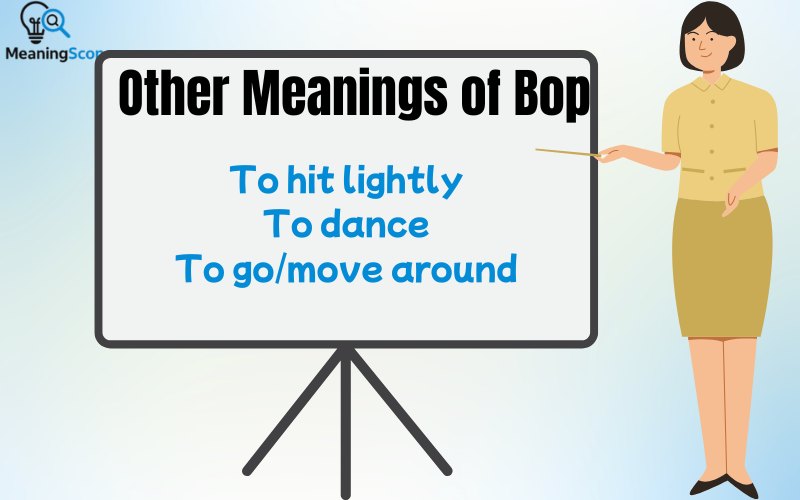
“Bop” has additional everyday definitions:
- As a verb meaning to hit lightly or playfully, such as “bop someone on the head.”
- To walk or move in a bouncy, casual manner, like “bopping down the street.”
- A simple dance style involving rhythmic hopping or swaying to music.
These uses are onomatopoeic, mimicking quick, light sounds or movements, and date back decades.
Related Post: What Does NPC Mean? Best Guide to the Popular Slang 📱😂
(FAQs)
What is the difference between bebop and regular jazz?
Bebop is more complex, fast-paced, and improvisation-heavy compared to earlier swing jazz, which was designed for dancing and featured larger bands with arranged parts.
Is calling someone a “bop” offensive?
In the derogatory slang sense, yes—it is often used to shame or insult, primarily targeting women, and is considered inappropriate by many.
Why do people say a song is a “bop”?
It means the song is catchy, fun, and makes you want to dance or move along with the rhythm, serving as a compliment in modern music discussions.
Conclusion
The term “bop” illustrates the dynamic nature of language, shifting from a revolutionary jazz style in the 1940s to diverse modern slang with both positive and negative applications. Its various meanings reflect cultural changes, musical evolution, and social influences over time. Recognizing context is essential when encountering or using the word, as it can convey appreciation for music, describe an action, or unfortunately carry harmful intent. Ultimately, “bop” highlights how a single word can encapsulate rich history and ongoing linguistic adaptation.

