


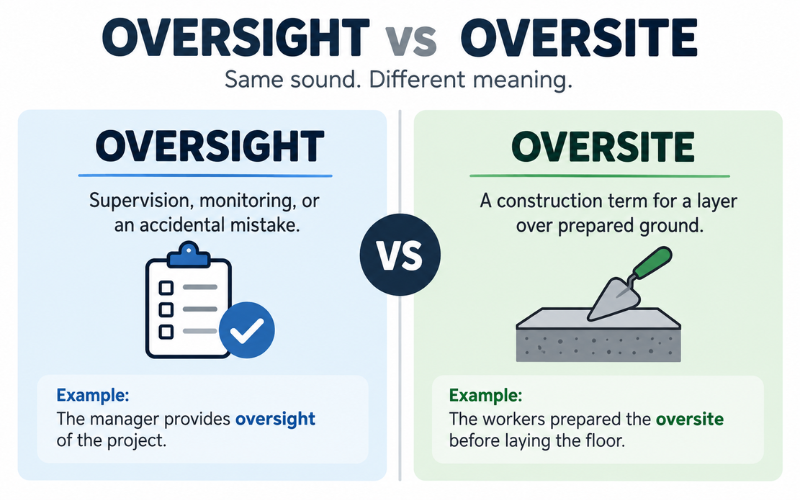
Words that look almost identical can be surprisingly difficult to distinguish, especially when they sound the same when spoken. Oversight and oversite are a good example. They differ by only one letter, but they are not interchangeable words.
The confusion usually comes from the endings “sight” and “site.” Both sound the same, so it is easy to write the wrong spelling when you hear the word in conversation. However, their meanings are quite different.
Oversight is the common English word. It can mean supervision, monitoring, or responsibility for something. It can also mean an accidental mistake or omission caused by failing to notice something.
Oversite is a much less common and specialized term associated mainly with construction and building work. It can refer to a layer or surface placed over prepared ground as part of a building’s floor construction.
Understanding the difference is important because using “oversite” when you mean “oversight” can make otherwise professional writing look like it contains a spelling mistake. In this guide, we will explain both words in detail, compare their meanings, look at real examples, discuss common mistakes, and show you an easy way to remember which spelling to use.
Oversight vs Oversite: Quick Answer
Oversight and oversite are different words with different meanings.
Oversight is normally used when talking about supervision, monitoring, management responsibility, or something that was accidentally missed.
Oversite is a specialized construction term used in building-related contexts.
| Word | Main Meaning | Typical Context | Example |
| Oversight | Supervision or accidental omission | Business, workplace, government, education, everyday English | “The committee provides oversight of the project.” |
| Oversite | Construction-related layer or surface | Building and construction | “The workers prepared the oversite before continuing the floor construction.” |
The easiest rule to remember is:
Oversight = supervision or something accidentally missed.
Oversite = a specialized construction term.
If you are writing an email and want to say that you forgot something, use oversight.
“Forgetting to attach the file was an oversight.”
If you are describing someone responsible for monitoring a project, use oversight.
“The manager provides oversight of the project.”
If you are discussing a technical construction process involving an oversite, the less common spelling may be appropriate.
What Does Oversight Mean?
Oversight is a noun with two major meanings in modern English. The correct meaning depends on the context in which the word is used.
The first meaning is supervision or monitoring. When a person or organization has oversight of something, they are responsible for watching, reviewing, or supervising it.
The second meaning is an accidental omission or mistake. In this sense, an oversight happens when someone fails to notice, remember, include, or consider something.
For example:
“The director has oversight of the entire department.”
Here, oversight means supervision.
Now consider:
“Leaving the final page out of the report was an oversight.”
Here, oversight means an accidental omission.
These two meanings may initially seem very different, but both are common and natural uses of the same word.
Oversight Meaning Supervision
One of the most important meanings of oversight is supervision.
When someone has oversight of a project or organization, they have a responsibility to monitor what is happening and make sure things are being handled correctly.
For example:
“The project manager provides oversight of the construction team.”
This means the project manager supervises or monitors the team.
Another example is:
“The board has oversight of the company’s financial activities.”
Here, the board is responsible for monitoring financial matters.
Oversight in this sense is often associated with higher-level supervision rather than performing every individual task personally.
Examples of Oversight as Supervision
“The director provides oversight of the department.”
“The committee has oversight of the program.”
“The organization operates under independent oversight.”
“The manager is responsible for project oversight.”
“The board provides financial oversight.”
In all of these examples, oversight means supervision, monitoring, review, or responsibility.
Oversight Meaning an Accidental Mistake
The second major meaning of oversight is an accidental mistake caused by failing to notice or remember something.
This is extremely common in everyday English.
For example:
“Forgetting to send the email was an oversight.”
The sentence suggests that the email was not deliberately ignored. It was simply missed.
Another example is:
“The missing attachment was an oversight.”
Again, the meaning is that someone accidentally failed to include it.
An oversight can involve something very small, such as a typo, missing name, forgotten attachment, or overlooked detail. It can also involve something more important.
Examples of Oversight as an Omission
“Leaving her name off the list was an oversight.”
“The missing information was an unfortunate oversight.”
“Forgetting to check the figures was an oversight.”
“I apologize for the oversight.”
“The error appears to have been a simple oversight.”
The common idea is that something was missed unintentionally.
Why Does Oversight Have Two Meanings?
The two meanings of oversight can be confusing because they may appear to point in opposite directions.
One meaning is connected with watching and supervising.
The other describes failing to notice something.
However, modern English allows the word to carry both meanings, and context normally makes the intended meaning clear.
Compare these sentences:
“The board provides oversight of the organization.”
This means the board supervises or monitors the organization.
Now compare:
“The board’s failure to review the document was an oversight.”
Here, oversight means something was accidentally missed.
When you see the word in a sentence, look at the surrounding words rather than assuming that it has only one meaning.
What Does Oversite Mean?
Oversite is a much less common word than oversight.
It is primarily associated with construction terminology. In building contexts, it can refer to a layer or surface placed over prepared ground, often as part of the construction of a floor.
Because the word is uncommon outside construction, many people assume that “oversite” is simply a misspelling of “oversight.” In general writing, that assumption is usually reasonable, but in a construction document, the specialized term may be intentional.
For example:
“The contractor prepared the oversite before continuing with the floor construction.”
The word is being used in a technical building context.
Oversite in Construction
Construction projects often involve several stages between the original ground and a finished floor.
Ground may need to be prepared, leveled, compacted, and covered with appropriate materials before later parts of the floor are installed. In certain construction terminology, the prepared layer or concrete surface over the ground is referred to as the oversite.
The exact construction method can vary depending on the building design, materials, location, and project specifications.
For this reason, oversite should be understood primarily as a specialized technical term rather than as an everyday alternative to “oversight.”
Construction Examples of Oversite
“The workers prepared the oversite before moving to the next stage.”
“The contractor inspected the oversite.”
“The concrete oversite formed part of the floor construction.”
“The building plans included details about the oversite.”
“The inspector checked the oversite during the construction process.”
The construction context makes the unusual spelling meaningful.
Oversight vs Oversite: The Main Difference
The simplest way to distinguish the words is to focus on sight and site.
Oversight contains sight.
Sight is connected with seeing, noticing, and observing. This makes it easy to associate oversight with supervision or something that was missed.
Oversite contains site.
A site is a place or location, and the word is especially relevant when discussing a building or construction site.
The basic distinction is therefore:
Oversight → sight → seeing, noticing, supervising
Oversite → site → construction and building
This memory trick is useful because pronunciation alone may not help.
Sight vs Site
The difference between sight and site is at the heart of the spelling problem.
Sight is associated with vision or seeing.
For example:
“The mountain came into sight.”
“She lost sight of the car.”
“The problem was immediately within sight.”
Site, on the other hand, usually means a place or location.
For example:
“The workers arrived at the construction site.”
“The company purchased a new site.”
“The building site was inspected before construction began.”
Because sight and site sound alike, it is easy to confuse them in words such as oversight and oversite.
A Simple Memory Trick for Oversight vs Oversite
A useful memory trick is to remember the final word inside each spelling.
Oversight = Sight
Think:
Sight → seeing → noticing → supervision
If you are talking about someone watching over a project, think oversight.
If you are talking about something that someone failed to notice, think oversight.
Oversite = Site
Think:
Site → place → building site → construction
If you encounter the word in specialized construction terminology, oversite may be the correct spelling.
A very simple rule is:
If it is about noticing or supervising, choose oversight.
If it is a construction term, consider oversite.
How Is Oversight Pronounced?
Oversight is generally pronounced like:
OH-ver-site
The final part sounds like “sight.”
Oversite is also pronounced very similarly. In many situations, the pronunciation does not give you enough information to determine which spelling is intended.
This is why context is more important than sound.
If someone says:
“It was an oversight.”
you need to understand the meaning to know the spelling.
If they mean:
“Something was accidentally missed,”
the spelling is oversight.
If they are discussing a specialized construction layer, oversite may be intended.
Examples of Oversight in Everyday English
The word oversight is common in everyday communication when someone accidentally forgets or misses something.
For example:
“Sorry, that was an oversight.”
This is a natural way to acknowledge a small mistake.
You might also say:
“I apologize for the oversight.”
This usually means that you accidentally failed to do something or include something.
Other examples include:
“Forgetting the appointment was an oversight.”
“Leaving your name off the list was an oversight.”
“The missing page was an oversight.”
“I didn’t mean to leave that out; it was an oversight.”
These sentences all use the mistake-related meaning.
Examples of Oversight in Business
Business writing frequently uses oversight to describe supervision and responsibility.
For example:
“The director has oversight of the company’s operations.”
This means the director monitors or supervises those operations.
You may also encounter phrases such as financial oversight, management oversight, operational oversight, and project oversight.
Business Examples
“The finance department provides oversight of the annual budget.”
“The director has overall oversight of the project.”
“The company introduced additional oversight procedures.”
“The committee is responsible for oversight of the program.”
In professional contexts, the word often suggests organized monitoring rather than direct involvement in every individual task.
Examples of Oversight in Government
Government and public organizations often use oversight to describe monitoring and accountability.
For example:
“The committee provides oversight of government spending.”
Here, the committee is responsible for reviewing and monitoring spending.
Other examples include:
“The agency operates under regulatory oversight.”
“The program requires independent oversight.”
“The committee called for stronger oversight.”
“The organization is subject to government oversight.”
In these sentences, oversight has nothing to do with an accidental mistake. It means supervision or monitoring.
Examples of Oversight in Education
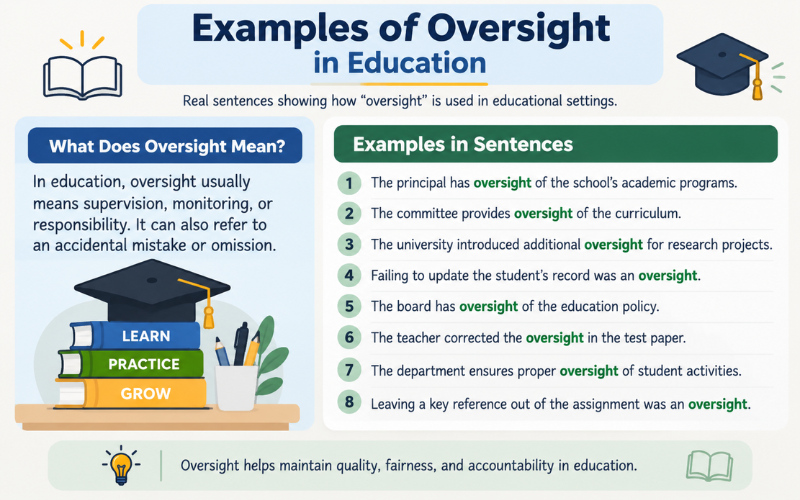
Schools, colleges, and universities can also use the word when discussing supervision.
For example:
“The principal has oversight of the school’s academic programs.”
A university committee might provide oversight of a research program, while an administrator might have oversight of a department.
The mistake-related meaning is also possible:
“Failing to update the student’s record was an oversight.”
Again, the surrounding context determines the meaning.
Oversight in Project Management
Project management is another area where oversight is frequently used.
A project may involve multiple people, deadlines, budgets, tasks, and risks. A manager may not perform every task personally, but they can have responsibility for monitoring the overall project.
For example:
“The project manager provides oversight throughout the development process.”
This means the manager watches the project’s progress and helps make sure everything stays on track.
Common phrases include:
- Project oversight
- Managerial oversight
- Financial oversight
- Operational oversight
- Quality oversight
Example
“Strong project oversight helped the team identify problems early.”
Oversight in Technology
Technology teams also use oversight in both of its major meanings.
For supervision:
“The engineering manager provides oversight of the development team.”
For an accidental omission:
“The broken button was an oversight during the website update.”
Other examples include:
“The security team provides oversight of system access.”
“The missing error message was an oversight.”
“The project requires technical oversight.”
This makes the word particularly useful in technology-related professional writing.
Oversight in Writing and Editing
Writers, editors, and content creators often use oversight when talking about something accidentally missed during proofreading or editing.
For example:
“The spelling mistake was an oversight.”
“Leaving out the final paragraph was an oversight.”
“The editor corrected several small oversights.”
The word works well when the problem was unintentional.
For example, if an editor deliberately removes a paragraph, you would not normally call that an oversight. But if the paragraph was accidentally forgotten, the word fits naturally.
Oversight in Professional Emails
One of the most common professional uses of the word appears in apologies.
You might write:
“I apologize for the oversight. I have attached the missing document.”
Or:
“Thank you for bringing this oversight to our attention.”
Or:
“The missing information was an oversight on our part.”
These expressions can sound polite and professional when acknowledging an accidental omission.
However, it is still important to clearly explain what happened when the issue is significant.
Oversight in Finance
The phrase financial oversight is common in professional and organizational settings.
Financial oversight refers to monitoring financial activities, budgets, spending, controls, or reporting.
For example:
“The board provides financial oversight.”
Another example:
“The organization needs stronger financial oversight.”
Here, oversight refers to supervision, not an accidental mistake.
Oversight in Healthcare
Healthcare organizations can also use the word to describe supervision and governance.
For example:
“The board provides oversight of the healthcare program.”
A different use would be:
“Failing to update the record was an oversight.”
The first sentence describes supervision, while the second describes an accidental omission.
Oversight in Website Content
Website owners, editors, and developers often deal with many small details. As a result, accidental oversights are common.
For example:
“The missing meta description was an oversight.”
“The broken link was an oversight during the update.”
“The wrong heading was an oversight.”
These examples all require oversight, not oversite.
The subject may involve websites, but that does not make “oversite” appropriate.
Oversight in Design
Design work often involves many elements that need to be reviewed.
A designer might accidentally leave out a logo, text block, image, or other detail.
For example:
“The missing logo was an oversight.”
“The incorrect spacing was an oversight during the final revision.”
Here, the word refers to something that was unintentionally missed.
Oversight vs Mistake
Oversight and mistake are related but not identical.
A mistake is a broad term for something done incorrectly.
An oversight specifically suggests that something was missed, forgotten, or not noticed.
Compare these sentences:
“Entering the wrong number was a mistake.”
This means the person entered an incorrect number.
Now:
“Failing to enter the number was an oversight.”
This means the person forgot or failed to notice that the number needed to be entered.
The distinction may be small, but it can make your writing more precise.
Oversight vs Omission
An omission is something that has been left out.
An oversight can also refer to something left out, but it often suggests that the omission was accidental.
For example:
“The omission of the final paragraph affected the report.”
This simply describes the omission.
“The omission of the final paragraph was an oversight.”
This suggests that the paragraph was accidentally left out.
Therefore, the two words can overlap, but oversight adds the idea of something being unintentionally missed.
Oversight vs Error
An error is something incorrect.
An oversight is often something that was missed.
For example:
“There was an error in the calculation.”
The calculation itself is wrong.
But:
“Failing to check the calculation was an oversight.”
The failure to check it was the problem.
This distinction is useful in reports, workplace communication, and technical writing.
Oversight vs Overlook
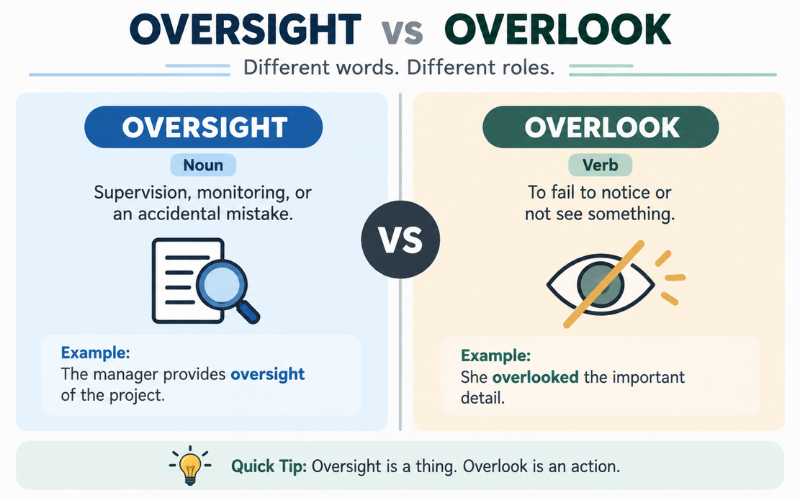
Overlook and oversight are closely related but have different grammatical functions.
Overlook is generally a verb.
Oversight is a noun.
For example:
“I overlooked the missing attachment.”
But:
“The missing attachment was an oversight.”
The first sentence describes what happened.
The second sentence names the situation.
Oversight vs Oversee
Oversee is a verb that means to supervise or manage.
Oversight is a noun that can mean supervision.
For example:
“The manager oversees the project.”
and:
“The manager provides oversight of the project.”
The two expressions are related, but their grammar is different.
You would normally use oversee when describing an action and oversight when naming the responsibility or supervision.
Oversight vs Supervision
Supervision is often a close synonym for the supervision-related meaning of oversight.
However, supervision can suggest more direct management, while oversight can suggest broader monitoring or responsibility.
For example:
“The supervisor provides daily supervision.”
This may suggest direct involvement with employees.
On the other hand:
“The board provides oversight of the organization.”
This suggests broader monitoring rather than daily management.
Oversight vs Management
Management usually involves actively organizing and directing something.
Oversight can be broader and may involve monitoring whether something is being managed correctly.
For example:
“The manager handles daily operations.”
while:
“The board provides oversight of those operations.”
This distinction is particularly useful in organizational and corporate writing.
Is Oversite a Common Word?
No, oversite is much less common than oversight.
Most English speakers regularly encounter oversight in emails, articles, reports, business communication, and everyday conversation.
By contrast, oversite is mainly encountered in specialized construction contexts.
That difference in frequency explains why many people assume “oversite” is simply a spelling mistake.
When Should You Use Oversight?
Use oversight when you mean:
- Supervision
- Monitoring
- Management responsibility
- Review
- Accountability
- An accidental omission
- Something unintentionally missed
- Failure to notice something
For example:
“The committee provides oversight of the program.”
Or:
“Forgetting to include the document was an oversight.”
If either meaning applies, oversight is the correct general word.
When Should You Use Oversite?
Use oversite only when the specialized construction meaning is intended.
It may appear in discussions involving:
- Building construction
- Floor construction
- Ground preparation
- Concrete work
- Construction specifications
- Building inspections
- Architectural or engineering documents
For example:
“The contractor prepared the oversite before continuing construction.”
If your sentence has nothing to do with construction terminology, check whether you actually mean oversight.
Common Oversight vs Oversite Mistakes
Because the words sound alike, spelling mistakes are common.
Mistake: Calling an accidental omission an oversite
Incorrect:
“Forgetting to attach the document was an oversite.”
Correct:
“Forgetting to attach the document was an oversight.”
Mistake: Using oversite for supervision
Incorrect:
“The manager provides oversite of the department.”
Correct:
“The manager provides oversight of the department.”
Mistake: Using oversite for a typo
Incorrect:
“The typo was an oversite.”
Correct:
“The typo was an oversight.”
Mistake: Assuming every construction-related sentence uses oversite
Construction itself does not automatically mean oversite.
For example:
“The engineer provided oversight of the construction project.”
This means the engineer supervised the construction.
The word is still oversight, even though the subject is construction.
This is an important distinction.
Construction Oversight vs Construction Oversite
These two phrases can look especially confusing.
Construction oversight means supervision or monitoring of construction work.
For example:
“The engineer provided construction oversight.”
This means the engineer monitored the project.
Construction oversite, when used in the specialized technical sense, refers to the oversite layer or surface associated with building construction.
For example:
“The contractor prepared the oversite.”
The difference is therefore based on meaning, not simply on the fact that both words can appear in construction documents.
Oversight Word Forms
Oversight is a noun.
When you need a verb meaning “to supervise,” the normal word is oversee.
For example:
“She oversees the project.”
For the noun:
“She provides oversight of the project.”
When you mean that someone failed to notice something, use overlook as the verb:
“She overlooked the error.”
Then:
“The error was an oversight.”
Understanding these related forms can help prevent grammatical and spelling mistakes.
Oversee, Overlook, and Oversight
These three words are particularly useful to compare.
| Word | Type | Meaning | Example |
| Oversee | Verb | Supervise | “She oversees the project.” |
| Overlook | Verb | Fail to notice | “She overlooked the error.” |
| Oversight | Noun | Supervision or accidental omission | “The error was an oversight.” |
A simple way to remember them is:
Oversee = supervise
Overlook = fail to notice
Oversight = supervision or something missed
Common Phrases With Oversight
The following expressions are common in English:
Provide oversight
“The committee provides oversight of the program.”
Have oversight of
“The director has oversight of the department.”
Under oversight
“The project operates under independent oversight.”
Financial oversight
“The board provides financial oversight.”
Regulatory oversight
“The industry is subject to regulatory oversight.”
Managerial oversight
“The project requires managerial oversight.”
An oversight
“Forgetting the attachment was an oversight.”
These phrases can help you understand how the word naturally appears in different types of writing.
Common Construction Phrases With Oversite
Because oversite is specialized, it has a much narrower range of uses.
You may encounter phrases such as:
- Concrete oversite
- Prepare the oversite
- Oversite preparation
- Oversite level
- Inspect the oversite
- Oversite construction
The precise terminology can vary depending on the construction system and region.
The important point is that the word belongs to a specialized building context.
Oversight in Everyday Conversation
The mistake-related meaning of oversight is especially natural in casual conversation.
Someone might say:
“Sorry, I forgot to send it. It was an oversight.”
Or:
“I completely overlooked that. It was an oversight.”
Or:
“That was a small oversight on my part.”
These sentences communicate that something was accidentally missed.
Oversight in Formal Writing
The word also works well in formal writing.
For example:
“The committee provides independent oversight of the process.”
Or:
“The omission was identified as an oversight during the final review.”
Because the word has a professional tone, it appears frequently in reports, policies, business documents, and organizational writing.
Oversight in Academic Writing
Academic writers may use oversight when discussing either supervision or accidental omissions.
For example:
“The study was conducted under institutional oversight.”
Or:
“The omission of this variable was an oversight.”
The correct meaning is determined by the surrounding context.
Oversight in Workplace Communication
In workplace communication, oversight can be a polite way to acknowledge that something was missed.
For example:
“I apologize for the oversight.”
This can be appropriate when an employee forgets an attachment, misses a detail, or leaves something out of a document.
Still, clarity is important. If the mistake had a serious consequence, it is often better to explain exactly what happened instead of relying only on the word “oversight.”
Oversite in Technical Writing
If you are writing for a construction audience, using the correct technical terminology matters.
A building specification might use oversite in a completely legitimate way.
For a general audience, however, the word may need explanation because many readers will be more familiar with oversight.
This is a good example of why technical vocabulary can have meanings that are unfamiliar to everyday readers.
How to Choose the Correct Spelling
When you are unsure, ask yourself what you mean before choosing the spelling.
If you mean supervision:
Use oversight.
“The manager provides oversight.”
If you mean something was accidentally missed:
Use oversight.
“The missing file was an oversight.”
If you mean a specialized construction layer:
Use oversite, when that is the technical term intended.
“The contractor prepared the oversite.”
This simple process can eliminate most spelling mistakes.
A Quick Replacement Test
Another useful trick is to replace the word with a simpler phrase.
If you can replace it with supervision, choose oversight.
“The board provides oversight.”
becomes:
“The board provides supervision.”
If you can replace it with accidental omission, choose oversight.
“The missing information was an oversight.”
becomes:
“The missing information was an accidental omission.”
If the sentence describes a specialized construction layer, then oversite may be appropriate.
Why Pronunciation Causes Confusion
The spelling problem exists because sight and site are homophones.
They are pronounced alike but have different meanings and spellings.
This means that when someone says oversight aloud, you cannot always determine the spelling simply by listening.
For this reason, people sometimes write oversite when they mean oversight.
The solution is to connect the spelling to the meaning rather than the sound.
Oversight vs Oversite for Students
Students should be especially careful with these words in assignments.
If you write:
“The missing citation was an oversite.”
your reader may interpret it as a spelling error.
The correct sentence is:
“The missing citation was an oversight.”
Similarly:
“The school board provides oversight of the program.”
is correct when discussing supervision.
When you encounter oversite in a reading assignment, look for a construction-related context before assuming that it is a typo.
Oversight vs Oversite for Content Writers
Content writers often need to explain confusing words clearly.
When writing about mistakes, management, supervision, or professional responsibility, oversight is usually the appropriate word.
For example:
“Failing to update the article was an oversight.”
If you are writing about construction and encounter the technical term oversite, make sure the context clearly supports its use.
Using the wrong spelling can make an otherwise polished article appear less reliable.
Oversight vs Oversite for Professional Communication
Professional communication requires attention to small spelling differences.
Compare:
“The manager has oversight of the project.”
with:
“The manager has oversite of the project.”
The first sentence clearly means supervision.
The second may look like a spelling mistake unless the writer is intentionally using a specialized construction term.
Therefore, when writing business emails, reports, proposals, or general professional documents, oversight is normally the correct choice when you mean supervision.
20 Examples of Oversight
Here are some examples showing both major meanings of the word.
- The committee provides oversight of the project.
- The manager has oversight of the department.
- The board provides financial oversight.
- The agency operates under regulatory oversight.
- The director is responsible for overall oversight.
- Strong project oversight can improve coordination.
- The missing attachment was an oversight.
- Forgetting the deadline was an oversight.
- Leaving her name off the list was an oversight.
- The typo was a simple oversight.
- I apologize for the oversight.
- The missing information was an unfortunate oversight.
- The broken link was an oversight during the website update.
- The error was caused by an oversight.
- The organization needs stronger managerial oversight.
- The program requires independent oversight.
- The committee has oversight of the new policy.
- Failing to check the final figures was an oversight.
- The missing paragraph was an oversight during editing.
- The project was completed under careful oversight.
10 Examples of Oversite
The following examples demonstrate the specialized construction use.
- The contractor prepared the oversite before continuing construction.
- Workers inspected the oversite before moving to the next stage.
- The building plans included information about the oversite.
- The concrete oversite formed part of the floor construction.
- The inspector examined the oversite during the project.
- The workers prepared the ground for the oversite.
- The construction team completed the oversite before installing the next layer.
- The contractor checked the oversite level.
- The project specifications described the required oversite.
- The oversite formed part of the building’s floor construction.
These examples demonstrate how different the construction term is from the everyday word oversight.
Oversight vs Oversite Grammar Comparison
| Feature | Oversight | Oversite |
| Part of speech | Noun | Noun |
| Everyday usage | Very common | Very uncommon |
| Supervision meaning | Yes | No |
| Accidental omission meaning | Yes | No |
| Construction usage | Can describe supervision | Specialized construction term |
| Related word | Oversee / overlook | Site |
| Main association | Seeing, noticing, supervision | Building site and construction |
| Common in emails | Yes | Rarely |
| Common in business writing | Yes | Rarely |
| Common in construction terminology | Yes, for supervision | Yes, for the specialized term |
Final Verdict on Oversight vs Oversite
The difference between oversight and oversite is much easier to understand once you separate their meanings.
Oversight is the standard English word and has two major uses. It can mean supervision or monitoring, and it can also mean an accidental omission or something that was unintentionally missed.
For example:
“The board provides oversight of the organization.”
means the board supervises or monitors the organization.
Meanwhile:
“Forgetting to include the attachment was an oversight.”
means the attachment was accidentally missed.
Oversite is a much less common technical term. It is mainly associated with construction and building work, where it can refer to a layer or surface over prepared ground as part of floor construction.
The most useful memory trick is to look at the final part of each word.
Oversight → sight → seeing, noticing, supervision
Oversite → site → construction site
So, in ordinary writing, oversight is almost always the spelling you want when talking about supervision or something accidentally missed. Oversite should be reserved for the specialized construction meaning when that terminology applies.
If it is helpful for you and want more free guides then here we have more for you:
FAQs
Is Oversight or Oversite Correct?
Both spellings can be correct, but they have different meanings.
Oversight is the normal English word for supervision or an accidental omission. Oversite is a specialized construction term.
Is Oversite a Real Word?
Yes. Oversite is used as a specialized construction term. It is much less common than oversight and is mainly encountered in building-related contexts.
What Is the Difference Between Oversight and Oversite?
Oversight means supervision, monitoring, or an accidental omission.
Oversite is primarily a construction term associated with a layer or surface over prepared ground.
Is “It Was an Oversite” Correct?
Usually not.
If you mean that something was accidentally missed, the correct sentence is:
“It was an oversight.”
Is “Provide Oversite” Correct?
Not when you mean supervision.
The normal expression is:
“Provide oversight.”
For example:
“The committee provides oversight of the project.”
Is Oversight a Noun or Verb?
Oversight is a noun.
For example:
“The project requires careful oversight.”
The verb meaning “to supervise” is oversee:
“She oversees the project.”
What Does Oversight Mean in Business?
In business, oversight usually means supervision, monitoring, review, or responsibility.
For example:
“The director provides oversight of the department.”
What Does Oversight Mean in an Apology?
In an apology, oversight usually refers to an accidental omission or mistake.
For example:
“I apologize for the oversight.”
This means something was accidentally missed.
Conclusion
Oversight vs oversite is a classic example of how a single letter can completely change the meaning of a word.
The common word is oversight. You use it when talking about supervision, monitoring, management responsibility, or an accidental omission. It is perfectly natural to say that a manager provides oversight, that a committee has oversight of a program, or that forgetting to attach a document was an oversight.
Oversite, in contrast, is a specialized construction term. It is mainly associated with building work and can describe a layer or surface placed over prepared ground as part of floor construction.
The pronunciation can make these words difficult because sight and site sound alike. That is why the safest approach is to remember their meanings instead of trying to spell them from sound.
When you mean seeing, noticing, supervising, or accidentally missing something, choose oversight.
When you encounter the specialized construction term associated with a site and building work, oversite may be the appropriate spelling.
The simplest rule to keep in mind is:
Oversight = supervision or something accidentally missed.
Oversite = specialized construction terminology.
Once you remember the difference between sight and site, choosing between oversight and oversite becomes much easier.
For More Info Visit: Meaningscope

