


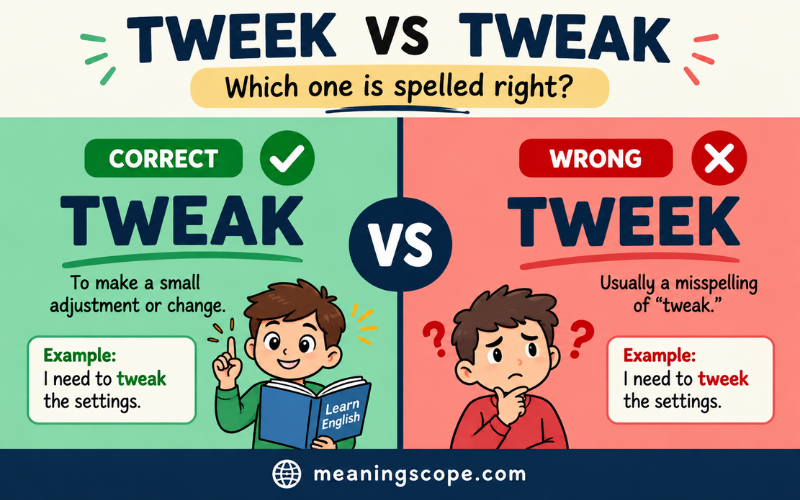
If you have ever wondered about Tweek vs Tweak, you are probably confused by one small spelling difference. Both words look almost identical, and they are pronounced very similarly. However, when you are writing standard English, the difference between them is important.
The correct spelling for the common English word meaning to make a small change or adjustment is “tweak.” The spelling “tweek” is usually a misspelling of tweak.
For example:
I need to tweak the settings.
Not:
I need to tweek the settings.
The confusion mainly comes from pronunciation. Tweak is pronounced approximately like “tweek,” so it is easy to assume that the word should be written with ee instead of ea.
In this article, we will explain the difference between tweek vs tweak, what each spelling means, why people confuse them, how to remember the correct spelling, and how to use tweak correctly in different situations.
Tweek vs Tweak: Quick Answer
If you are looking for a simple answer, here it is:
Tweak is the correct standard English spelling when you mean to make a small adjustment or change.
Tweek is generally an incorrect spelling when used with that meaning.
| Spelling | Standard English? | Meaning |
| Tweak | Yes | Make a small adjustment or change |
| Tweek | Usually no | Common misspelling of “tweak” |
| Tweaked | Yes | Past tense of tweak |
| Tweeked | Usually no | Common misspelling |
| Tweaking | Yes | Making small adjustments |
| Tweeking | Usually no | Common misspelling |
| Tweaks | Yes | Small adjustments |
| Tweeks | Usually no | Common misspelling |
So, whenever you mean “make a small adjustment,” use tweak.
What Does Tweak Mean?
Tweak is a standard English word that can be used as both a verb and a noun.
The most common meaning of tweak is to make a small change or adjustment to something. Usually, the thing being changed is already working or mostly finished, and only a few details need to be improved.
For example:
I need to tweak my website before publishing it.
This sentence suggests that the website is already mostly complete. The writer only needs to make a few small changes.
You can tweak almost anything, including:
- A website
- A computer setting
- A piece of writing
- A recipe
- A design
- A presentation
- A business strategy
- A schedule
- Software
- A photograph
- A marketing campaign
The central idea is usually small adjustment rather than complete change.
Tweak as a Verb
As a verb, tweak means to make a slight adjustment, modification, or improvement.
For example:
She tweaked the article before publishing it.
Here, tweaked means that she made some small changes to the article.
Another example is:
We need to tweak the design.
This suggests that the design is generally acceptable but needs some minor improvements.
Tweak as a Noun
Tweak can also be used as a noun.
In this case, it means a small adjustment or modification.
For example:
The website needs a small tweak.
Here, tweak is the adjustment itself.
The plural form is tweaks:
We made several tweaks to the website.
This means that several small changes were made.
Other Meanings of Tweak
Tweak can also have physical meanings.
It can describe pulling or twisting something slightly:
She tweaked his ear.
In this sentence, tweaked means that she pulled or twisted the ear slightly.
The word can also be used informally when talking about a minor injury:
I tweaked my knee while running.
Here, tweaked means that the person suffered a small injury or strain.
The intended meaning depends on the context.
What Does Tweek Mean?
When people search for “tweek meaning,” they are often asking whether tweek is another spelling of tweak.
In standard English, tweek is generally not the correct spelling when you mean “make a small adjustment.”
For example:
I need to tweek the settings.
This should normally be written as:
I need to tweak the settings.
The spelling tweek is easy to produce because the pronunciation of tweak sounds like “tweek.”
However, pronunciation does not always tell you the exact spelling of an English word.
There can also be special situations where Tweek is used as a name, character name, username, or other proper term. In those cases, it should be judged according to its specific context.
Tweak vs Tweek: Main Difference
The main difference between tweak and tweek is spelling.
Tweak
Tweak is the standard English word.
It means to:
- Make a small adjustment
- Modify something slightly
- Improve something through minor changes
- Fine-tune something
Example:
I need to tweak the settings.
Tweek
Tweek is generally a misspelling when the intended meaning is “make a small adjustment.”
Example:
I need to tweek the settings.
Correct version:
I need to tweak the settings.
Therefore, the simple rule is:
TWEAK = correct standard spelling
TWEEK = usually incorrect spelling
Why Do People Spell Tweak as Tweek?
There are several reasons people make this mistake.
Tweak and Tweek Sound the Same
The biggest reason is pronunciation.
Tweak sounds approximately like:
“tweek”
When someone hears the word rather than sees it written, they may naturally assume that it contains ee.
That can lead to:
tweek
instead of:
tweak
English Uses EA and EE in Similar Sounds
English spelling can be confusing because both ea and ee can represent similar long vowel sounds.
For example:
- Week
- Seek
- Sleep
- Meet
- Weak
- Speak
- Leak
- Tweak
Because people are familiar with words such as week and seek, they may instinctively choose ee when spelling tweak.
Fast Typing Causes Spelling Mistakes
Another reason is simple typing speed.
When people write quickly, they may type tweek without consciously thinking about the vowel combination. This is especially common in casual messages, comments, notes, and online discussions.
Pronunciation Does Not Always Reveal Spelling
English contains many words whose spelling cannot be predicted perfectly from pronunciation.
That is why it is better to memorize the spelling of tweak instead of trying to reconstruct it from the sound.
How to Remember the Correct Spelling of Tweak
There is an easy trick that can help you remember the spelling.
Think of the word:
WEAK
Now add a T at the beginning:
T + WEAK = TWEAK
This gives you:
TWEAK
The important part is that both weak and tweak contain EA.
The Weak + T Spelling Trick
Whenever you are unsure whether to write tweak or tweek, remember:
WEAK → TWEAK
Do not think:
WEEK → TWEEK
Instead, think:
WEAK → TWEAK
This is one of the simplest ways to remember the correct spelling.
How Is Tweak Pronounced?
Tweak is pronounced approximately like “tweek.”
Its pronunciation is commonly represented as:
/twiːk/
This explains why the spelling can be confusing.
You pronounce it roughly like:
tweek
but spell it:
tweak
So remember:
Sound = “tweek”
Spelling = “tweak”
Examples of Tweak in a Sentence
The word tweak can be used in many different situations.
Here are some examples:
I need to tweak the settings.
She tweaked the article before publishing it.
We made a few tweaks to the design.
The developer tweaked the software.
He tweaked the recipe to make it less sweet.
I need to tweak my schedule.
The team tweaked its strategy.
The presentation only needs a few tweaks.
These examples all use the standard spelling tweak.
Tweak in Technology
Tweak is extremely common in technology.
People often tweak settings, software, applications, devices, and configurations.
For example:
I tweaked the graphics settings to improve performance.
This usually means that only certain settings were changed rather than the entire system.
You can tweak:
- Display settings
- Graphics settings
- Audio settings
- Computer configurations
- Phone settings
- Software
- Applications
- Game settings
- User interfaces
Tweak in Website Development
Web developers often use the word tweak when talking about small changes to a website.
For example:
I need to tweak the CSS.
Let’s tweak the page layout.
We should tweak the spacing.
The homepage needs a few tweaks.
A developer might tweak:
- Font sizes
- Margins
- Padding
- Colors
- Button positions
- Image sizes
- Alignment
- Mobile layouts
- Typography
- Page spacing
The word is useful because website development often involves making many small changes rather than rebuilding a page completely.
Tweak in Writing
Writers and editors frequently use tweak.
For example:
I need to tweak the introduction.
This means that the introduction is mostly complete but needs some small improvements.
You might tweak:
- A headline
- An introduction
- A paragraph
- A sentence
- Word choice
- Grammar
- Formatting
- A conclusion
For example:
The editor tweaked the headline to make it clearer.
This suggests a small change rather than a complete rewrite.
Tweak in Business
Businesses also use tweak when discussing strategies and processes.
For example:
We need to tweak our marketing strategy.
This usually means the company wants to improve the existing strategy rather than replace it entirely.
You can tweak:
- Pricing
- Marketing campaigns
- Sales strategies
- Product features
- Customer messaging
- Business plans
- Advertising
- Internal processes
Tweak in Design
Designers often make many small changes before finalizing their work.
For example:
The designer made a few tweaks to the logo.
These tweaks might involve:
- Font size
- Spacing
- Alignment
- Proportions
- Layout
- Colors
- Positioning
The word tweak is particularly useful because it communicates the idea of refinement.
Tweak in Cooking
You can also tweak a recipe.
For example:
I tweaked the recipe by adding less sugar.
This means that the original recipe was changed slightly.
Another example:
You can tweak the ingredients according to your taste.
The recipe remains basically the same, but a few details are adjusted.
Tweak in Photography
Photographers and image editors can tweak photos before publishing them.
For example:
She tweaked the brightness and contrast.
You can tweak:
- Brightness
- Contrast
- Exposure
- Cropping
- Shadows
- Highlights
- Color balance
- Saturation
Again, the idea is usually a small adjustment rather than a complete transformation.
Tweak in Presentations
You may also tweak a presentation before showing it to an audience.
For example:
I tweaked the slides before the meeting.
This could mean changing the wording, spacing, images, layout, or order of a few slides.
Tweak in Everyday Conversation
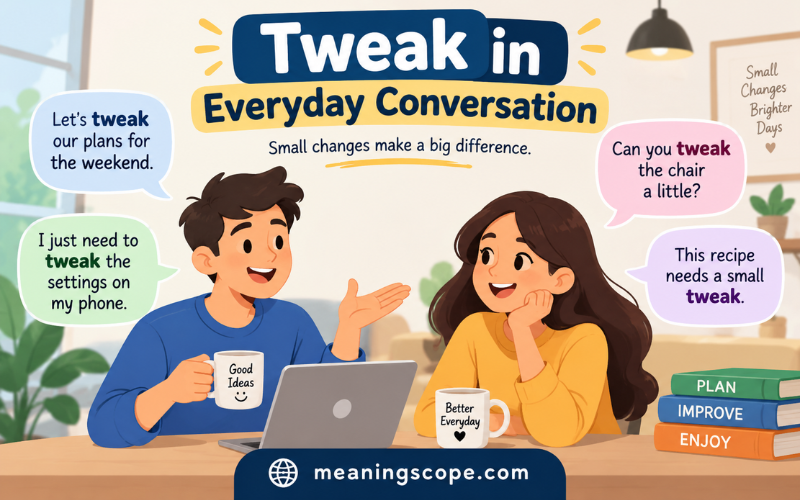
Tweak is not limited to professional or technical situations.
It can be used casually in everyday conversation.
For example:
I tweaked my schedule for tomorrow.
Can you tweak the chair a little?
We should tweak the plan.
This recipe needs a small tweak.
I tweaked the settings on my phone.
These sentences show that the word is useful in many ordinary situations.
Tweak vs Change
Change is a broader word than tweak.
Change can describe a very small modification or a major transformation.
For example:
The company changed its business model.
We do not know from this sentence how large the change was.
Now compare:
The company tweaked its business model.
This suggests that the basic model remained in place and only certain parts were adjusted.
So:
Change = any type or size of modification
Tweak = usually a small adjustment
Tweak vs Adjust
Tweak and adjust are very similar.
For example:
Adjust the brightness.
Tweak the brightness.
Both can be correct.
However, adjust is more neutral, while tweak often sounds more casual and suggests a smaller modification.
Tweak vs Modify
Modify means to change something, but it does not necessarily indicate that the change is small.
For example:
We modified the design.
This could mean a small or significant modification.
By comparison:
We tweaked the design.
This usually suggests relatively minor changes.
Tweak vs Fine-Tune
Fine-tune is another close alternative to tweak.
Both words can describe making small improvements to something that already exists.
For example:
We need to fine-tune the settings.
We need to tweak the settings.
The difference is mainly in tone and emphasis.
Fine-tune often emphasizes careful optimization, while tweak can sound more casual.
Tweak vs Revise
Revise is commonly used when making changes to writing, plans, or other developed material.
For example:
I revised the article.
This does not tell us whether the changes were small or large.
By contrast:
I tweaked the article.
usually suggests smaller modifications.
Tweak vs Edit
Edit is a broad term that can include many types of changes.
You can edit something by:
- Correcting grammar
- Removing information
- Adding information
- Changing wording
- Reorganizing sections
- Rewriting sentences
If you say:
I edited the article.
the amount of work is unclear.
If you say:
I tweaked the article.
the reader will usually expect relatively small changes.
Tweak vs Alter
Alter means to change something, but it does not necessarily imply a minor change.
For example:
We altered the design.
This could involve a significant modification.
By comparison:
We tweaked the design.
usually indicates smaller changes.
Is Tweek Ever Used?
Yes, Tweek can appear in specific contexts.
For example, it can be used as a character name, username, brand name, title, or another proper name.
One well-known example is Tweek Tweak, a fictional character from South Park.
In such a case, Tweek is a name rather than an alternative spelling of the ordinary English word tweak.
Therefore, you should consider context.
If you are writing:
I need to tweek the settings.
then tweek is normally a spelling mistake.
But if you are referring to a person or character whose name is Tweek, the spelling may be intentional.
Is Tweak Formal or Informal?
Tweak is a standard English word and can be used in professional communication.
For example:
We need to tweak the proposal before sending it.
This is perfectly understandable in a business environment.
However, in highly formal or technical writing, you may sometimes prefer words such as:
- Adjust
- Modify
- Revise
- Refine
- Make minor changes
The best word depends on the context and the level of formality you want.
Tweak in Technical Writing
Tweak can be useful in technical communication, especially when talking about small adjustments.
For example:
The developer tweaked the configuration.
However, highly technical documents may benefit from more precise language.
Instead of:
Tweak the system.
you might write:
Adjust the system parameters.
The second sentence provides a more formal and specific instruction.
Tweak in Professional Communication
The word is common in business communication when the speaker wants to describe a small improvement.
For example:
We may need to tweak the proposal.
Let’s make a few tweaks to the presentation.
The team tweaked the pricing strategy.
These sentences sound natural in workplace conversations.
Tweak in Creative Work
Creative professionals often use tweak because creative projects normally go through multiple rounds of small adjustments.
A writer may tweak:
- Headlines
- Sentences
- Paragraphs
- Word choices
A designer may tweak:
- Layout
- Typography
- Spacing
- Alignment
A photographer may tweak:
- Exposure
- Contrast
- Color
A video editor may tweak:
- Timing
- Audio
- Transitions
- Color
In each case, the word suggests refinement.
Tweak in Sports
Tweak is also common in sports.
A coach might say:
We need to tweak our strategy.
This means the team needs to make a few changes without completely abandoning its existing approach.
The word can also describe a minor injury:
He tweaked his ankle during practice.
Here, tweaked means that he suffered a minor injury or strain.
Tweak in Relationships and Social Situations
You can even use tweak when talking about plans or behavior in social situations.
For example:
We need to tweak our plans for the weekend.
This means the original plans will be adjusted slightly.
Another example:
She tweaked her approach to the conversation.
This suggests that she changed her approach a little.
Tweak, Tweaked, Tweaking, and Tweaks
Once you know the correct spelling of tweak, its other forms are easy to understand.
Tweak
This is the base form:
I need to tweak the settings.
Tweaks
This can be the plural noun:
We made several tweaks.
It can also be the third-person singular verb:
She tweaks the design regularly.
Tweaked
This is the past tense:
He tweaked the article yesterday.
Tweaking
This is the present participle:
They are tweaking the website.
The important point is that all these forms are based on tweak, not tweek.
Is Tweaked or Tweeked Correct?
The correct form is:
Tweaked
Not:
Tweeked
For example:
She tweaked the website.
The spelling retains the ea from tweak.
Is Tweaking or Tweeking Correct?
The correct form is:
Tweaking
Not:
Tweeking
For example:
We are tweaking the design.
Again, the base word is tweak.
Are Tweaks or Tweeks Correct?
The correct plural form is:
Tweaks
For example:
The website needs several tweaks.
Tweeks is generally incorrect when it is intended to be the plural of tweak.
Common Tweak vs Tweek Mistakes
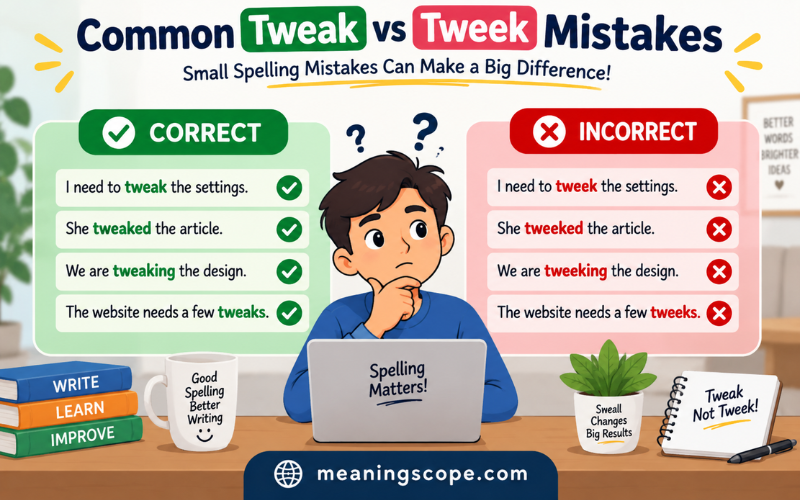
The most common errors happen because people spell the word according to its pronunciation.
Incorrect: Tweek
I need to tweek the settings.
Correct: Tweak
I need to tweak the settings.
Incorrect: Tweeked
She tweeked the article.
Correct: Tweaked
She tweaked the article.
Incorrect: Tweeking
We are tweeking the design.
Correct: Tweaking
We are tweaking the design.
Incorrect: Tweeks
The website needs a few tweeks.
Correct: Tweaks
The website needs a few tweaks.
Common Misconceptions About Tweak
There are several misunderstandings surrounding this word.
Tweek Is an Alternative Spelling of Tweak
Usually, no.
When you mean “make a small adjustment,” the standard spelling is tweak.
Tweak Only Refers to Technology
No.
You can tweak writing, recipes, designs, business plans, schedules, presentations, strategies, and many other things.
Tweak Always Means Improvement
Not necessarily.
It often describes an adjustment intended to improve something, but the word can also describe physical actions or minor injuries.
Tweak Means a Major Change
Usually not.
Tweak normally suggests a relatively small change.
If the change is major, words such as transform, replace, rebuild, or overhaul may be more appropriate.
When Should You Use Tweak?
Use tweak when:
- Something is already mostly complete
- Only small changes are needed
- You want to improve something slightly
- You are fine-tuning settings
- You are refining a design
- You are making minor edits
- You are adjusting a plan
For example:
The article is almost finished; I just need to tweak the introduction.
This clearly communicates that only minor work remains.
When Should You Use Change Instead?
Use change when you want a broad word that does not specify the size of the modification.
For example:
We changed the website.
This could mean anything from changing one small detail to completely rebuilding the site.
Use tweak when you specifically want to communicate a smaller adjustment.
When Should You Use Adjust Instead?
Use adjust when you want a neutral and widely applicable word.
For example:
Please adjust the volume.
This sounds natural and neutral.
Tweak could also work:
Please tweak the volume.
But it sounds somewhat more casual.
Tweak vs Tweek for Students
Students may encounter this spelling issue when writing assignments or essays.
For example:
Incorrect:
I tweeked my essay before submitting it.
Correct:
I tweaked my essay before submitting it.
If a teacher tells you to tweak your essay, they usually mean that you should make some small improvements rather than rewrite the entire assignment.
Tweak vs Tweek for Bloggers
Bloggers frequently use tweak when talking about small content improvements.
For example:
I tweaked the introduction to make it clearer.
You might also say:
The article needs a few tweaks before publication.
This can refer to changes in:
- Headings
- Paragraphs
- Formatting
- Word choice
- Internal links
- Titles
- Introductions
- Conclusions
Tweak vs Tweek for Developers
Developers commonly use tweak when making small technical changes.
For example:
I need to tweak the CSS.
The developer tweaked the code.
We made a few tweaks to the interface.
In all these examples, tweak is the correct spelling.
Tweak vs Tweek: Quick Grammar Comparison
| Form | Correct | Incorrect |
| Base verb | tweak | tweek |
| Third-person verb | tweaks | tweeks |
| Past tense | tweaked | tweeked |
| Present participle | tweaking | tweeking |
| Singular noun | tweak | tweek |
| Plural noun | tweaks | tweeks |
A simple way to remember all of these forms is to learn the base spelling tweak first.
Tweak vs Tweek Examples for Students
Correct Tweak Examples
I tweaked my essay before submitting it.
The teacher suggested a few tweaks to my introduction.
I need to tweak this sentence.
Incorrect Tweek Examples
I tweeked my essay.
The teacher suggested a few tweeks.
I need to tweek this sentence.
The correct spelling is always based on tweak when you mean a small adjustment.
Tweak vs Tweek Examples for Bloggers
Correct Tweak Examples
I need to tweak the article title.
We made several tweaks to the introduction.
The blogger tweaked the formatting.
Incorrect Tweek Examples
I need to tweek the article title.
We made several tweeks.
The blogger tweeked the formatting.
Again, tweak is the standard spelling.
Tweak vs Tweek Examples for Developers
Developers can use tweak in sentences such as:
I need to tweak the CSS.
We tweaked the interface.
The developer is tweaking the configuration.
A few tweaks improved the performance.
Using tweek in these sentences would generally be a spelling mistake.
A Simple Rule for Tweak vs Tweek
If you only remember one rule, make it this:
When you mean “make a small adjustment,” use TWEAK.
Remember:
TWEAK = correct
TWEEK = usually incorrect
And use this spelling trick:
WEAK + T = TWEAK
This makes it much easier to remember the correct vowel combination.
FAQs
Is Tweak or Tweek Correct?
Tweak is the standard English spelling when you mean to make a small adjustment or change.
Is Tweek a Word?
Tweek is generally not the standard spelling of tweak. It is commonly a misspelling when someone intends to write tweak.
However, Tweek can be used as a proper name or in a specific context, so it is not automatically an error in every situation.
What Does Tweak Mean?
Tweak commonly means to make a small change or adjustment, especially to improve or fine-tune something.
It can also mean to pull or twist something slightly.
How Do You Pronounce Tweak?
Tweak is pronounced approximately like “tweek.”
This similar pronunciation is one of the main reasons people sometimes spell it incorrectly.
Why Is Tweak Spelled With EA Instead of EE?
English spelling does not always match pronunciation in a predictable way.
The easiest way to remember the spelling is to connect tweak with weak:
WEAK + T = TWEAK
Is Tweaked or Tweeked Correct?
Tweaked is correct.
For example:
I tweaked the settings.
Tweeked is generally an incorrect spelling when you mean the past tense of tweak.
Is Tweaking or Tweeking Correct?
Tweaking is correct.
For example:
She is tweaking the website.
Tweeking is generally a misspelling.
Is Tweaks or Tweeks Correct?
Tweaks is correct when referring to small adjustments.
For example:
We made several tweaks to the design.
Can Tweak Be a Noun?
Yes.
Tweak can be a noun meaning a small adjustment.
For example:
The design needs a small tweak.
Can Tweak Mean to Pull Something?
Yes.
Tweak can describe pulling or twisting something slightly.
For example:
She tweaked his ear.
Can Tweak Mean a Minor Injury?
Yes.
In informal usage, tweak can describe a minor injury or strain.
For example:
I tweaked my knee while running.
Is Tweak the Same as Change?
Not exactly.
Change is broader and can refer to modifications of any size. Tweak usually suggests a small adjustment.
Is Tweak the Same as Adjust?
They are very similar.
Adjust is more neutral, while tweak often sounds more casual and suggests a small modification.
Can Tweak Be Used in Professional Writing?
Yes.
Tweak is a standard English word and can be used in professional communication.
For highly formal writing, however, alternatives such as adjust, modify, or revise may sometimes be preferable.
How Can I Remember the Spelling of Tweak?
Use the simple spelling trick:
WEAK + T = TWEAK
Remember the EA in weak, and you will be much less likely to write tweek.
Tweek vs Tweak: Final Verdict
The difference between tweek vs tweak is mainly a spelling issue.
When you want to say that you are making a small adjustment, modifying something slightly, or fine-tuning something, the correct standard English word is:
TWEAK
The spelling tweek is generally incorrect when it is being used with this meaning.
The confusion is understandable because tweak is pronounced approximately like “tweek.” However, pronunciation does not determine the exact spelling. The best way to remember it is to connect the word with weak:
WEAK + T = TWEAK
You can use tweak when talking about websites, software, writing, recipes, designs, business strategies, presentations, schedules, sports strategies, and many other subjects.
Its common forms are:
- Tweak
- Tweaks
- Tweaked
- Tweaking
Avoid using:
- Tweek
- Tweeks
- Tweeked
- Tweeking
when you intend to use the standard English word.
There is one important exception: Tweek may be correct when it is being used intentionally as a name, character name, username, brand, or another proper term. In those cases, the context determines whether the spelling is correct.
For ordinary English writing, though, the answer is simple:
Tweak is correct. Tweek is usually a misspelling.
Conclusion
When comparing tweek vs tweak, the correct standard English spelling is tweak when you mean to make a small change, adjustment, or improvement. The word can be used in many situations, including writing, technology, website design, business, cooking, and everyday conversation.
The confusion mainly comes from pronunciation because tweak sounds like “tweek.” However, the spelling is T-W-E-A-K, not T-W-E-E-K. An easy way to remember this is “weak + T = tweak.”
The related forms follow the same spelling pattern: tweaks, tweaked, and tweaking. In contrast, tweek, tweeks, tweeked, and tweeking are generally incorrect when they are intended to describe small adjustments.
So, if you are unsure which word to use, remember one simple rule: use “tweak” for a small adjustment. “Tweek” should only be used when it is intentionally written that way as a name or other specific term.
For More Info Visit: Meaningscope

