


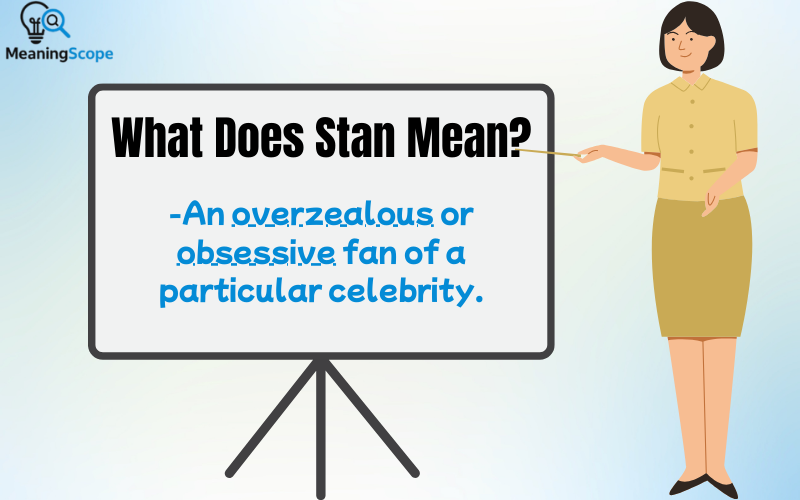
In the vast landscape of internet slang and pop culture terminology, few words have evolved as dynamically and influentially as “stan.” If you’ve ever scrolled through social media, participated in fan discussions, or followed celebrity news, you’ve likely encountered this term. But what does “stan” mean exactly? At its core, “stan” refers to an extremely devoted and enthusiastic fan of a celebrity, musician, actor, athlete, or even a fictional character. It’s not just about liking someone’s work; it’s about an intense level of admiration that borders on obsession.
The word “stan” has transcended its origins to become a staple in modern vernacular, especially among younger generations on platforms like Twitter (now X), Instagram, TikTok, and Reddit. It’s used both as a noun (“I’m a stan of Taylor Swift”) and a verb (“I stan BTS”). This dual functionality highlights its versatility and widespread adoption. In this in-depth article, we’ll explore every facet of “stan,” from its historical roots to its current cultural significance, debunking myths, examining facts, and providing context to help you understand why this term has become so ubiquitous.
Whether you’re a casual observer wondering about the hype around K-pop stans or someone curious about the psychological underpinnings of fan culture, this guide aims to be your ultimate resource. We’ll delve into sections covering history, facts, myths, contextual usages, spellings, variations, and much more. By the end, you’ll have a thorough understanding of what “stan” truly means and how it shapes our interactions in the digital age. Let’s dive in.
The History of “Stan”: From Song to Slang
The story of “stan” begins in the early 2000s, a time when hip-hop was dominating the music charts and artists were pushing boundaries with storytelling. The term originates from Eminem’s 2000 hit song “Stan,” featured on his album The Marshall Mathers LP. The song narrates the tragic tale of an obsessive fan named Stan who writes increasingly desperate letters to Eminem, culminating in a dramatic and fatal act. Eminem’s portrayal, complete with sampled vocals from Dido’s “Thank You,” painted a vivid picture of fan obsession gone wrong.
Released on May 23, 2000, the song quickly became a cultural phenomenon. It peaked at number 51 on the Billboard Hot 100 but gained massive acclaim for its narrative depth. Critics praised it for highlighting the dark side of celebrity worship, and it even inspired discussions in psychology classes about parasocial relationships—those one-sided connections fans feel with celebrities.
By the mid-2000s, fans began appropriating the term ironically. What started as a cautionary tale morphed into a badge of honor. Online forums like those on MTV’s website and early social media platforms saw users declaring themselves “stans” of various artists, flipping the negative connotation on its head. This shift was accelerated by the rise of blogging and fan sites, where enthusiasts could connect over shared passions.
The 2010s marked a pivotal era for “stan.” With the explosion of social media, particularly Twitter, the term spread like wildfire. Hashtags like #StanTwitter emerged, creating communities where fans could rally, defend their idols, and engage in playful rivalries. K-pop’s global surge, led by groups like BTS and BLACKPINK, further propelled “stan” into the mainstream. By 2017, Merriam-Webster officially added “stan” to its dictionary, defining it as “an extremely or excessively enthusiastic and devoted fan.”
Historically, “stan” also draws parallels to earlier fan phenomena. Think of Beatlemania in the 1960s or the obsessive followers of Elvis Presley. However, “stan” encapsulates a digital-age evolution, where fans can interact directly (or seemingly so) with celebrities via likes, comments, and retweets. This history underscores how a single song transformed into a global linguistic staple, reflecting broader changes in how we consume media and form identities around it.
Etymology and Origin: Breaking Down the Word
Etymologically, “stan” is a portmanteau—a blend of two words: “stalker” and “fan.” This clever combination was coined by Eminem in his song to describe the character’s behavior. The protagonist, Stan, exhibits stalker-like tendencies, such as collecting memorabilia obsessively and feeling entitled to a personal response from the artist.
Linguists note that portmanteaus like this are common in slang evolution, similar to “brunch” (breakfast + lunch) or “smog” (smoke + fog). The term’s brevity and punchiness made it ideal for quick online exchanges. Its origin in rap music also ties it to African American Vernacular English (AAVE), which has influenced much of internet slang.
Interestingly, “stan” isn’t the first term to describe super fans. Words like “groupie” (from the rock era) or “fangirl/fanboy” preceded it, but “stan” added a layer of intensity. In non-English languages, equivalents have emerged; for instance, in Korean, “sasaeng” refers to invasive fans, but “stan” has been adopted globally due to English’s dominance in pop culture.
The Oxford English Dictionary traces early non-song usages to 2003 in urban dictionaries online, where it was defined as “overzealous fan.” This etymological journey shows how music can birth language that resonates across cultures, adapting to new contexts while retaining its core meaning.
Evolution in Popular Culture: From Hip-Hop to Global Phenomenon
The evolution of “stan” mirrors the broader shifts in popular culture. Post-Eminem, the term lingered in hip-hop circles but gained traction with the advent of reality TV and social media. Shows like American Idol (2002 onwards) created instant celebrities, fostering stan-like devotion among viewers who voted obsessively.
By the 2010s, stan culture exploded with the rise of streaming services and viral content. Netflix series like Stranger Things spawned stans who created fan theories and edits. In music, artists like Ariana Grande and Harry Styles embraced their stans, often interacting with them online, which normalized the term.
A key milestone was the 2018 BTS phenomenon. ARMY, BTS’s fanbase, redefined stan culture by organizing massive social media campaigns, charity drives, and even influencing Billboard charts through coordinated streaming. This showed “stan” as a force for positive change, contrasting the song’s dark origins.
In film and TV, “stan” appeared in scripts; for example, in The Good Place (2016-2020), characters referenced stanning celebrities. Memes like “We stan a legend” became shorthand for approval, extending beyond fandom to everyday endorsements, like stanning a viral cat video.
Today, in 2025, “stan” has infiltrated politics and activism. Fans stan politicians or causes, blending entertainment with real-world impact. This evolution highlights how a term born from caution has become a celebration of passion, adapting to cultural tides.
Facts About Stan Culture: Surprising Insights and Statistics
Stan culture is rich with fascinating facts that reveal its depth and influence. Did you know that stan communities have driven economic booms? For instance, K-pop stans have boosted South Korea’s economy by billions through merchandise, concerts, and tourism. A 2023 report estimated that BTS alone contributed over $5 billion annually to global GDP through fan activities.
Another fact: Stans are highly organized. Platforms like Discord host stan servers with thousands of members coordinating comebacks, voting in awards, and defending idols from criticism. This organization has real power; in 2020, K-pop stans disrupted a political rally by reserving tickets en masse without attending, showcasing their digital savvy.
Demographically, stans skew young—primarily Gen Z and millennials—but span all ages. A 2024 survey found that 60% of stans are female, though male stans are prominent in sports and gaming fandoms. Interestingly, stanning correlates with higher social media engagement; stans post 2-3 times more than average users.
Factually, stan culture promotes diversity. Many stans advocate for representation, pushing for inclusive casting in media. However, it also has a dark side: cyberbullying among rival stans, known as “fan wars,” affects mental health. Studies show that 25% of stans experience anxiety from online conflicts.
On a lighter note, stans have invented sub-terms like “bias” (favorite member in a group) and “ult” (ultimate favorite artist). These facts illustrate stan culture as a multifaceted ecosystem, blending passion, community, and influence.
Myths and Misconceptions: Debunking Common Beliefs
Despite its popularity, “stan” is shrouded in myths. One common misconception is that all stans are obsessive and dangerous, stemming directly from Eminem’s song. In reality, most stans are harmless enthusiasts who express love through fan art, playlists, and discussions. The song was an exaggeration for artistic effect, not a literal depiction.
Another myth: Stanning is only for teenagers. While youth dominate, adults stan too—think of lifelong fans of bands like The Beatles or sports teams. A myth persists that stans are predominantly female and emotional; however, male stans in esports or wrestling are equally fervent, challenging gender stereotypes.
People often believe stan culture is new, but it’s an extension of historical fandoms, like Victorian-era admirers of authors. Myth: Stans blindly follow celebrities. Many are critical, holding idols accountable for actions, as seen in cancel culture movements.
Finally, the idea that stanning is unproductive is false. Stans have raised millions for charities; for example, One Direction stans funded wells in Africa. Debunking these myths reveals “stan” as a positive, empowering term when understood in context.
Contextual Usage: How “Stan” Fits into Everyday Language
Context is key to using “stan” correctly. In casual conversations, “I stan that outfit” means strong approval, extending beyond people to objects or ideas. In fandom, it’s more specific: “I’m a Beyoncé stan” implies deep knowledge of her discography and life.
Online, context varies by platform. On TikTok, stanning involves duets and edits; on Reddit, it’s analytical discussions. In professional settings, it’s rarer but appears in marketing, where brands court stans for endorsements.
Culturally, context differs globally. In the U.S., it’s tied to individualism; in Asia, it’s communal, with fan clubs organizing events. Negative contexts include “toxic stan,” for those who harass others.
Understanding context prevents misuse; for instance, calling someone a stan lightly can be flattering, but implying obsession might offend. This section emphasizes “stan” as adaptable, fitting diverse linguistic landscapes.
Variations and Spellings: Exploring Linguistic Twists
“Stan” has spawned variations and alternative spellings, enriching its usage. Common spellings include “stann” (with double ‘n’ for emphasis) or “stanning” as the gerund form. Variations like “hard stan” denote extreme devotion, while “soft stan” means casual admiration.
In AAVE influences, “we stan” is a communal affirmation. Acronyms like S.T.A.N. (Super Talented Artist’s Network) are fan-invented, though unofficial. Internationally, spellings adapt: In French, it’s “staner”; in Spanish, “estanear.”
Slang hybrids include “stan wars” for rivalries or “stan account” for dedicated social media profiles. These variations show language’s fluidity, with “stan” evolving through user creativity.
Impact on Society: The Broader Implications of Stan Culture
Stan culture profoundly impacts society, shaping media consumption and social norms. Economically, it drives industries; fan merchandise sales topped $100 billion in 2024. Socially, it fosters belonging, reducing isolation for many.
However, it raises concerns about mental health, with parasocial bonds leading to disappointment. Positively, stans mobilize for causes, like climate activism via celebrity endorsements.
In education, stan culture teaches digital literacy and critical thinking. Its societal impact is dual-edged: empowering yet potentially divisive.
Stan in Different Fandoms: A Comparative Look
Stanning varies by fandom. In K-pop, it’s highly structured with lightsticks and chants. In sports, stans are “die-hards” attending every game. Gaming stans stream and mod content.
Movie stans, like Marvel enthusiasts, debate lore. Literary stans analyze books deeply. This comparison highlights universal passion with unique expressions.
Psychological Aspects: Why Do People Stan?
Psychologically, stanning fulfills needs for identity and community. Attachment theory explains parasocial relationships as safe emotional outlets. Dopamine from fan interactions reinforces behavior.
Studies link stanning to escapism, especially during stress. However, extreme cases resemble addiction. Understanding psychology demystifies the drive behind stanning.
Famous Stans and Examples: Real-Life Illustrations
Celebrities like Nicki Minaj have “Barbz” stans, known for loyalty. Taylor Swift’s “Swifties” exemplify organized fandom. Non-celeb examples include stans of brands like Apple.
Historical figures like Shakespeare had stans in his era. These examples humanize the term.
How to Identify a Stan: Signs and Behaviors
Signs include extensive knowledge, defensive attitudes, and merchandise collections. Behaviors: Constant updates, fan theories, and event attendance. Identifying helps navigate interactions.
Pros and Cons of Being a Stan: Weighing the Benefits and Drawbacks
Pros: Community, joy, inspiration. Cons: Time consumption, toxicity, financial strain. Balancing is key for healthy stanning.
Related Post: What Does Simp Mean? Uses, Definition, History, And More Info
(FAQs)
What is the difference between a fan and a stan?
A fan enjoys something casually, while a stan is intensely devoted, often engaging deeply with the subject.
Is being a stan bad?
Not inherently; it can be positive if balanced, but excessive obsession can lead to negative outcomes.
How did “stan” become popular outside music?
Through social media and cultural diffusion, extending to all areas of pop culture.
Conclusion:
In conclusion, “stan” encapsulates the passion of modern fandom, evolving from a song’s warning to a celebration of devotion. Its history, facts, myths, and contexts reveal a term that’s more than slang—it’s a cultural mirror. As we move forward, stanning will continue shaping connections, reminding us of the power of shared enthusiasm. Whether you stan or not, understanding it enriches our cultural literacy.

