


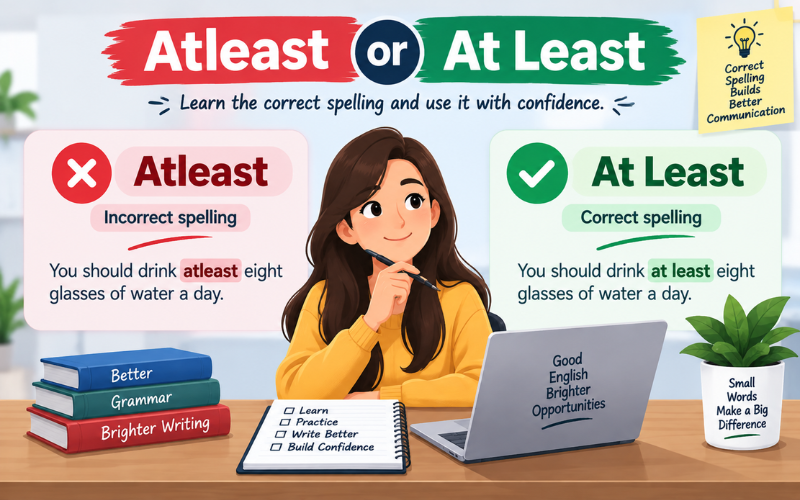
The spelling confusion between atleast or at least is very common, especially when people are writing quickly or typing informal messages. Although the two forms look almost identical, only one is considered correct in standard English. The correct spelling is at least, written as two separate words.
The incorrect form atleast is often seen in online searches, social media posts, text messages, and informal writing. However, it should not be used in standard English, particularly in professional, academic, or published content.
The phrase at least is useful in many different situations. It can describe a minimum number, amount, age, distance, period of time, or requirement. It can also introduce a positive point when a situation has an unfavorable result. Because of these different uses, understanding the phrase involves more than simply learning its spelling.
This guide explains atleast vs at least, including the correct spelling, meaning, grammar, examples, common mistakes, related expressions, mathematical meaning, and practical usage.
If you want to compare this guide with other guides visit our these guides Offered vs Offerred, Manuel vs Manual.
Atleast or At Least
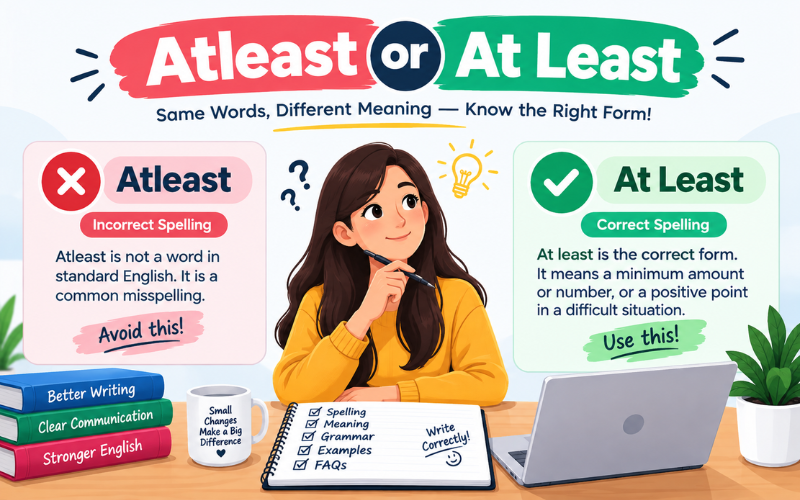
The correct form is at least.
The incorrect form is atleast.
The phrase is written as two separate words:
at + least = at least
For example, if a requirement says that applicants must have at least two years of experience, it means two years is the minimum. Someone with three, four, or more years of experience also meets that requirement.
The phrase can also be used in a different way. If someone says that a trip was disappointing but at least the weather was good, they are pointing out something positive despite the disappointing experience.
Is Atleast Correct?
No. Atleast is not the standard spelling of the phrase.
Although it is easy to find this form in informal online writing, combining the words into one word is considered a spelling error in standard English.
The correct form is always:
at least
This applies whether you are using the phrase in casual writing, professional communication, academic work, website content, or formal documents.
Why Is At Least Written as Two Words?
The expression is made up of the preposition at and the word least. They work together to create a phrase, but they remain separate words.
English contains many expressions that function as a unit without being combined into one word. At least is one of them.
Therefore, writing the phrase as atleast changes the standard spelling even though most readers will still understand what the writer intended.
For correct English, keep the two words separate.
What Does At Least Mean?
The meaning of at least depends on the context.
Its most common meaning is a minimum amount or number. In this use, it means that the stated amount is the lowest possible or acceptable amount.
For example, saying that a room can hold at least 100 people means that 100 is the minimum capacity being claimed. The actual capacity could be higher.
The phrase can also mean that something is true even if another part of the situation is negative. In a sentence such as “We lost the match, but at least we played well,” the phrase introduces the positive part of the situation.
Therefore, at least has two especially useful meanings:
- A minimum amount or number
- A positive or favorable point in an otherwise negative situation
At Least as a Minimum
The most frequent use of at least is to establish a lower limit.
When someone says that something requires at least five minutes, the meaning is five minutes or longer. Five is acceptable, but four minutes would not satisfy the stated minimum.
This makes the phrase particularly useful when discussing:
- Numbers
- Quantities
- Time
- Age
- Money
- Distance
- Measurements
- Experience
- Requirements
- Capacity
For example, a job advertisement might require at least three years of experience. A competition might require participants to be at least 18 years old. A delivery service might state that shipping takes at least five business days.
In each case, at least establishes the minimum.
At Least Does Not Mean Exactly
One of the most important things to understand is that at least does not mean exactly.
If someone says they need exactly five documents, the required number is five and no more or fewer.
If they say they need at least five documents, five is the minimum, but six, seven, or more may also be acceptable.
The difference can be summarized as follows:
| Expression | Meaning |
| Exactly 5 | Only 5 |
| At least 5 | 5 or more |
| More than 5 | Greater than 5 |
| At most 5 | 5 or fewer |
This distinction is particularly important when dealing with instructions, rules, applications, contracts, measurements, and mathematical statements.
At Least vs More Than
At least and more than are related, but they are not identical.
At least five includes five itself. More than five does not include five.
For example, if a school requires students to attend at least 10 classes, a student who attends exactly 10 classes satisfies the requirement.
If the requirement says students must attend more than 10 classes, attending exactly 10 would not be enough.
This small difference can significantly change the meaning of a rule or requirement.
At Least vs At Most
Another useful comparison is at least vs at most.
At least establishes a minimum.
At most establishes a maximum.
If a form requires at least two references, the applicant needs two or more.
If an event allows at most two guests, the person can bring two or fewer.
| Phrase | Meaning |
| At least 10 | 10 or more |
| At most 10 | 10 or fewer |
Remembering these two expressions together can make numerical instructions much easier to understand.
At Least in Everyday English
The phrase at least appears frequently in everyday conversation.
People use it when talking about time, money, distance, quantities, plans, and expectations.
Someone might say that they need at least 20 minutes before leaving. A customer might say that a product costs at least $50. A traveler might explain that the journey takes at least three hours.
These uses are straightforward because the phrase establishes a minimum.
However, everyday English also uses at least to emphasize something positive.
For example, a person who missed an event might say that at least they were able to meet a friend afterward. The phrase draws attention to the favorable part of an otherwise disappointing situation.
At Least as a Positive Expression
One of the most interesting uses of at least is its ability to introduce a positive point.
Consider a situation where someone did not achieve their main goal but still had a good experience. They might say that they did not win the competition, but at least they gained valuable experience.
Here, at least does not refer to a number or minimum quantity. Instead, it means something similar to “the good thing is”.
Other common situations include:
- A trip was delayed, but everyone arrived safely.
- A project was difficult, but it was completed.
- Someone did not win, but they learned something.
- The weather was cold, but it did not rain.
- A person made a mistake, but they recognized it and corrected it.
In each case, at least highlights something positive.
At Least With Numbers
Using at least with numbers is extremely common.
Examples include:
- At least one person
- At least two hours
- At least five dollars
- At least 20 participants
- At least 100 pages
- At least 500 meters
The number following at least represents the minimum.
For example, “at least 20 participants” means the number of participants is 20 or greater.
This structure is common in requirements, statistics, instructions, advertisements, and general descriptions.
At Least With Time
The phrase is often used when discussing duration.
If someone says that a project will take at least two weeks, they are indicating that two weeks is the minimum expected time. The project could take longer.
Common examples include:
- At least 10 minutes
- At least one hour
- At least three days
- At least two weeks
- At least six months
This wording is useful when the exact duration is uncertain but a reasonable minimum can be established.
At Least With Age
At least is also frequently used for age requirements.
For example, if an activity is available to people who are at least 18 years old, the minimum age is 18.
Someone who is 18 qualifies, as does someone who is 19, 20, or older.
This expression is common in:
- Job requirements
- Competitions
- Events
- Courses
- Memberships
- Legal restrictions
- Educational programs
The important point is that the stated age is included.
At Least With Money
The phrase can establish a minimum financial amount.
For example, if a person says they need at least $100, they need $100 or more.
Similarly, a business may state that a purchase requires at least $50. This means an order worth $50 meets the minimum, while an order worth $49 does not.
This usage is common when discussing:
- Prices
- Budgets
- Salaries
- Savings
- Purchases
- Fees
- Investments
- Donations
At Least With Measurements
The phrase is useful when describing measurements that may not be exact.
For example, if a table is described as being at least six feet long, six feet is the minimum stated length. It could actually be longer.
The same structure can be used with:
- Inches
- Feet
- Centimeters
- Meters
- Kilometers
- Pounds
- Kilograms
- Liters
For example, a container may hold at least five liters, or a wall may be at least three meters wide.
This makes at least particularly useful when an exact measurement is unavailable but a minimum can be established.
At Least in Formal Writing
There is nothing informal or incorrect about using at least in formal writing.
The phrase is completely standard and can appear in academic papers, business reports, technical documentation, professional emails, research writing, and website articles.
For example, a research report might explain that the study involved at least 200 participants.
A company policy might state that employees must provide at least two references.
A technical document might explain that a device requires at least 10 minutes to complete a particular process.
The important point is to use the correct two-word spelling.
At Least in Academic Writing
Academic writers frequently use at least to describe minimum quantities or conditions.
For example, a study may have been repeated at least three times. A research sample may include at least 100 participants. Students may need to complete at least four assignments.
This wording is useful because it avoids claiming an exact number when the actual quantity may be greater.
It also helps academic writing remain precise when describing minimum requirements or lower limits.
At Least in Business English
Businesses commonly use at least when discussing requirements, deadlines, quantities, and qualifications.
A job advertisement may require applicants to have at least two years of relevant experience.
A supplier may require customers to purchase at least 100 units.
A company may tell customers to allow at least three business days for processing.
A manager might ask employees to provide at least two possible solutions to a problem.
In each example, the phrase clearly establishes a minimum.
At Least in Professional Emails
Professional emails often use the phrase when communicating deadlines or requirements.
For example, an employee might ask a colleague to allow at least two business days for a request to be processed.
A manager might ask a team member to provide at least three options before the next meeting.
A customer service representative might explain that a refund can take at least five business days.
These examples demonstrate that at least is natural in professional communication.
At Least in Conditional Sentences
The phrase can also appear naturally in conditional sentences.
For example, a sentence might explain that if someone wants to qualify for a program, they must score at least 80 percent.
Another conditional statement could explain that if an applicant wants to participate, they must be at least 18 years old.
In both cases, at least establishes a minimum condition that must be met.
At Least in Mathematical Language
The phrase has a precise mathematical meaning.
When a value is described as at least 10, it means the value is greater than or equal to 10.
This can be written as:
x ≥ 10
The symbol ≥ means “greater than or equal to.”
Therefore, values such as 10, 11, 12, 15, and 100 all satisfy the condition x ≥ 10.
A value such as 9 does not.
This mathematical meaning matches the everyday meaning of at least.
At Least vs Exactly in Mathematics
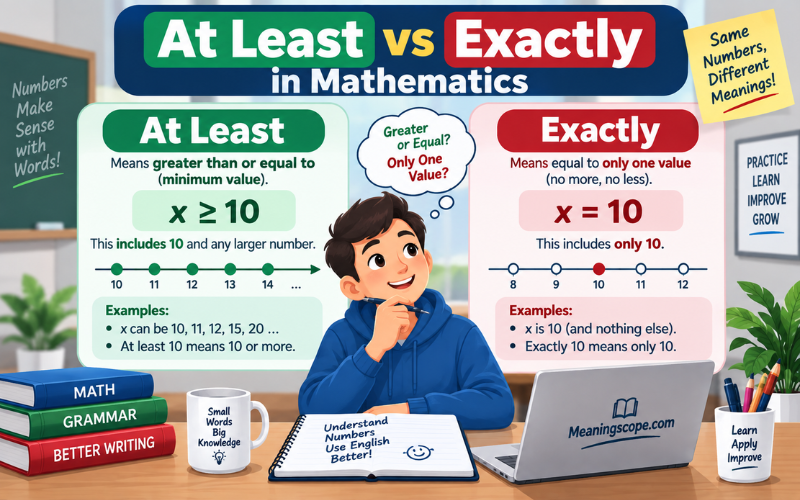
The mathematical difference is particularly clear.
If:
x = 10
the value is exactly 10.
If:
x ≥ 10
the value can be 10 or any larger number.
Therefore, at least includes the stated number, while more than excludes it.
For example:
- At least 10 → 10 or greater
- More than 10 → greater than 10
- Exactly 10 → 10 only
- At most 10 → 10 or less
Understanding these differences can prevent confusion when reading mathematical or technical instructions.
At Least vs At Last
Another common confusion involves at least and at last.
They are different phrases with different meanings.
At least generally refers to a minimum or introduces a positive point.
At last means finally or after a period of waiting.
For example, saying that a project will take at least two weeks establishes a minimum duration.
Saying that the project was finished at last means it was finally completed.
The spelling is also different:
at least
at last
Neither should be written as one word.
At Least vs Least
The word least can be used independently, but its meaning is different from the phrase at least.
For example, if someone says that one option costs the least, they mean it has the lowest cost among the options being compared.
When someone says that an option costs at least $50, they mean $50 is the minimum price.
Therefore, adding at changes the expression and its meaning.
At Least vs At the Least
The phrase at the least can sometimes appear in English, particularly when the speaker wants to emphasize a minimum.
However, at least is the normal and much more common expression.
For ordinary writing, phrases such as “at least two hours” or “at least five people” are the natural choices.
At the least may be used in certain structures, but it is not necessary when the simple phrase at least communicates the intended meaning.
At Least vs No Less Than
At least and no less than can sometimes communicate the same minimum.
For example, saying that a project requires at least three people and saying that it requires no less than three people both establish three as the minimum.
However, at least is generally more natural in everyday English.
No less than can sound more formal or emphatic and may be chosen when the writer wants to stress the size or importance of the number.
At Least vs Minimum
The words at least and minimum are closely related.
For example, the statement “The minimum age is 18” has essentially the same meaning as “You must be at least 18 years old.”
Likewise, “The minimum order is 10 units” communicates the same basic requirement as “You must order at least 10 units.”
The main difference is grammatical structure. Minimum is a noun or adjective depending on the sentence, while at least is a phrase.
Common Mistakes With At Least
Writing Atleast
The most common error is combining the two words.
Incorrect: atleast
Correct: at least
This mistake is easy to make when typing quickly, but it should be corrected in standard writing.
Confusing At Least With At Last
A person may write at last when they actually mean a minimum.
For example, if the intended meaning is “five or more,” the correct expression is at least five, not at last five.
Treating At Least as Exactly
Another mistake is assuming that “at least five” means exactly five.
It actually means five or more.
Using At Least When a Maximum Is Intended
If you mean a maximum, use at most, not at least.
For example, “at most five people” means five or fewer, while “at least five people” means five or more.
How to Remember the Correct Spelling
The easiest way to remember the spelling is to associate the phrase with the idea of a minimum.
Think:
At least = minimum
Then remember that the phrase contains two separate words.
You can also memorize a few common combinations:
- At least one
- At least two
- At least five
- At least 10
- At least once
- At least an hour
Seeing the phrase repeatedly in its correct form makes the spelling easier to remember naturally.
A Simple Test for At Least
If you are unsure whether to use at least, replace it mentally with “or more”.
For example:
At least five people
means:
Five people or more
If that meaning makes sense, at least is probably the correct phrase.
For the positive-expression meaning, you can think of at least as meaning “the good thing is.”
For example:
At least we tried
can be understood as:
The good thing is that we tried.
These two mental substitutions cover most everyday uses.
At Least in Everyday Examples
Here are some natural examples of the phrase in different contexts:
A person may need at least 30 minutes to finish a task.
A store may require customers to purchase at least five items.
A course may require students to attend at least 80 percent of the classes.
A building may be at least 50 years old.
A traveler may need at least two hours to reach the destination.
Someone may say that the day was difficult, but at least everything ended safely.
These examples demonstrate how flexible the phrase is.
At Least and Search Queries
People commonly search for variations such as:
- Atleast or at least
- At least or atleast
- Is atleast correct?
- Is at least one word?
- At least meaning
- At least definition
- How to spell at least
- Atleast meaning
- At least grammar
- At least examples
Most of these searches are asking the same basic question: whether atleast or at least is the correct spelling.
The answer is at least.
At Least: Quick Reference Table
| Question | Answer |
| Correct spelling | At least |
| Incorrect spelling | Atleast |
| Number of words | Two |
| Main meaning | Minimum |
| Numerical meaning | Stated amount or more |
| Opposite concept | At most |
| Similar expression | No less than |
| “Exactly” meaning? | No |
| Can it start a sentence? | Yes |
| Can it be used formally? | Yes |
| Mathematical meaning | Greater than or equal to |
At Least vs Atleast: Practice Examples
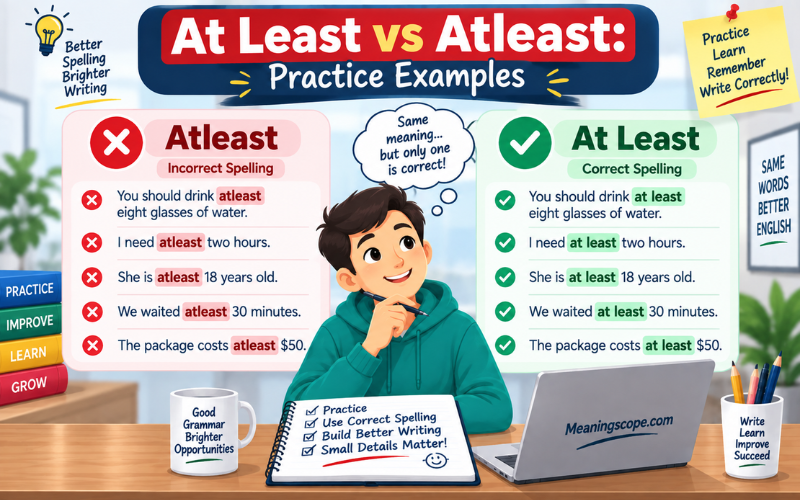
Try identifying the correct form in these examples.
Example 1
The project will take at least three days.
This is correct because three days is the minimum duration.
Example 2
Applicants must be at least 18 years old.
This is correct because 18 is the minimum age.
Example 3
You need at least two references.
This means two or more references are required.
Example 4
I didn’t win, but at least I learned something.
Here, the phrase introduces a positive point rather than a numerical minimum.
If it is helpful for you and want more free guides then here we have more for you:
- Nominato vs Nominee Differences, Meanings And More
- Oversight vs Oversite Differences And Correct Usage
- Tweek vs Tweak, Which One Is Correct?
FAQs
Is It Atleast or At Least?
The correct spelling is at least. It must be written as two separate words in standard English. Atleast is a common misspelling.
Is Atleast a Correct Word?
No. Atleast is not the standard spelling. The correct form is at least.
Is At Least One Word or Two?
At least is two words. The words should not be combined.
What Does At Least Mean?
At least commonly means a minimum amount or number. It can also introduce a positive point in an otherwise negative situation.
Does At Least Mean Exactly?
No. At least five means five or more, while exactly five means five and no more or less.
What Is the Difference Between At Least and More Than?
At least 10 includes 10 and higher values. More than 10 means a value greater than 10 and does not include exactly 10.
What Is the Difference Between At Least and At Most?
At least indicates a minimum, while at most indicates a maximum. At least five means five or more; at most five means five or fewer.
Can At Least Be Used With Numbers?
Yes. It is commonly used with numbers to establish a minimum quantity.
Can At Least Be Used With Time?
Yes. For example, saying something takes at least two hours means two hours is the minimum expected duration.
Can At Least Be Used With Age?
Yes. A requirement such as “at least 18 years old” means 18 or older.
Can At Least Be Used in Formal Writing?
Yes. At least is standard English and is completely appropriate for academic, professional, business, and formal writing.
What Is the Difference Between At Least and At Last?
At least means a minimum or can highlight something positive. At last means finally.
Can At Least Start a Sentence?
Yes. For example, it can introduce a positive point at the beginning of a sentence.
Is At Least Used in Mathematics?
Yes. In mathematics, at least 10 means greater than or equal to 10, represented by x ≥ 10.
What Is Another Way to Say At Least?
Depending on the context, alternatives can include at minimum, no less than, or a minimum of. The most natural alternative depends on the sentence.
Is Atleast Acceptable in Text Messages?
You may see atleast in informal messages, but it is still considered a spelling mistake in standard English. Use at least when you want correct spelling.
Why Do People Write Atleast?
People often combine the words because they sound like a single phrase and are frequently typed quickly. However, the standard spelling keeps them separate.
What Is an Easy Way to Remember At Least?
Remember the formula:
At least = minimum
Then remember that it contains two words.
Conclusion
The correct spelling is at least, not atleast. The phrase should always be written as two separate words in standard English.
The most common meaning of at least is to establish a minimum. When someone says they need at least five minutes, they mean five minutes or more. When an organization requires applicants to have at least two years of experience, two years is the minimum acceptable amount.
The phrase can also be used to identify a positive part of an otherwise disappointing situation. Saying that a person did not win but at least tried emphasizes the favorable aspect of the experience.
It is important not to confuse at least with at last or at most. At least indicates a minimum, at most indicates a maximum, and at last means finally.
The simplest rule is:
At least = correct
Atleast = incorrect
Whenever you are writing an article, email, assignment, business document, or social media post and need this phrase, keep at and least separate. Once you connect at least with the idea of a minimum or a positive point, the correct spelling becomes much easier to remember.
For More Info Visit: Meaningscope

